
Tankard
Unknown Artist
18th century
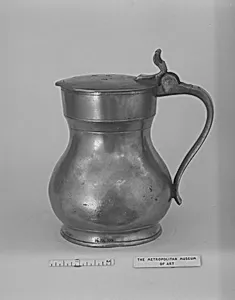
Medium
Pewter
Dimensions
5 1/2 × 3 1/2 in. (14 × 8.9 cm)
Classification
Metalwork-Pewter
Culture
Flemish
Department
European Sculpture and Decorative Arts
Museum
Metropolitan Museum of Art, New York, NY
Credit
Gift of Mr. Robert M. Parmelee and Mrs. William L. Parker, 1916
Accession Number
16.116.109
Rights
Public Domain
Art Historical Context
This elegant 18th-century Flemish tankard, crafted from pewter, exemplifies the refined metalwork traditions of Flanders—a region renowned for its skilled artisans in Antwerp and beyond. Standing at 5½ × 3½ inches (14 × 8.9 cm), this drinking vessel features the classic tankard form: a sturdy with a hinged lid to guard against spills or contaminants, and a practical handle for easy toasting. Pewter, an alloy primarily of tin with traces of lead or antimony, was prized for its silvery luster, malleability, and affordability, making it a democratic alternative to silver for middle-class households and taverns across Europe. In the bustling trade hubs of 18th-century Flanders, such tankards were everyday essentials for enjoying beer, ale, or wine during communal gatherings, reflecting the era's social customs and growing prosperity amid the Enlightenment. Though the artist remains unknown, the piece highlights the anonymous mastery of Flemish pewterers, whose techniques like casting, hammering, and seaming produced durable, functional art. Donated to The Metropolitan Museum of Art in 1916 by Mr. Robert M. Parmelee and Mrs. William L. Parker, it now invites us to appreciate how ordinary objects embodied cultural pride and craftsmanship.