
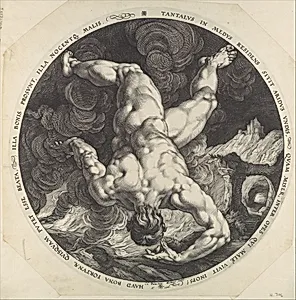
Tantalus, from "The Four Disgracers"
Medium
Engraving
Dimensions
13 1/4 x 13 1/4 in. (33.6 x 33.6 cm)
Classification
Prints
Department
Drawings and Prints
Museum
Metropolitan Museum of Art, New York, NY
Credit
Harris Brisbane Dick Fund, 1953
Accession Number
53.601.338(3)
Rights
Public Domain
Tags
Art Historical Context
In the late 16th century, artists Hendrick Goltzius and Cornelis Cornelisz Haarlem collaborated on *Tantalus, from " Four Disgracers" an engraving from 1588 that captures the eternal torment of the mythological king Tantalus. Part of a renowned series depicting figures punished in Hades—alongside Tityus, Ixion, and Sisyphus print shows Tantalus standing in receding water beneath unreachable fruit, embodying themes of hubris and divine retribution drawn from classical sources like Ovid's *Metamorphoses*. Produced in Haarlem during the Dutch Golden Age's early stirrings, it reflects Mannerist influences with its dramatic, elongated forms and muscular male nude, showcasing the era's fascination with antique mythology and human anatomy. Goltzius, a master engraver, executed the plate after Cornelisz van Haarlem's design, employing his signature "swelling line" technique—bold, varied strokes that mimic the effects of painting and create a sense of volume and movement. Measuring 13¼ x 13¼ inches, this square-format engraving exemplifies the medium's power for dissemination, allowing Northern European collectors to own virtuoso reproductions of complex compositions. Housed in the Metropolitan Museum of Art's Drawings and Prints department (Harris Brisbane Dick Fund, 1953), it highlights the Renaissance revival of pagan narratives amid religious tensions, inviting viewers to ponder moral lessons through exquisite technical prowess.
About the Artist
Hendrick Goltzius|Cornelis Cornelisz van Haarlem · 1558–1617
Hendrick Goltzius (1558–1617) was the most celebrated engraver of the Northern Renaissance and a pivotal figure in Dutch Mannerism. Born near the German-Dutch border, Goltzius transformed printmaking into a virtuoso art form through his revolutionary 'swelling line' technique, where the burin was manipulated to create lines of varying thickness that produced unprecedented tonal effects and three-d...