
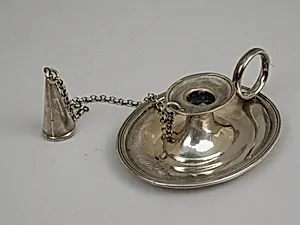
Taperstick
1798–99
Medium
Silver
Dimensions
Overall: 1 1/8 × 3 1/4 in. (2.9 × 8.3 cm)
Classification
Metalwork-Silver
Culture
British, Sheffield
Department
European Sculpture and Decorative Arts
Museum
Metropolitan Museum of Art, New York, NY
Credit
Gift of Louise and David Braver, 2006
Accession Number
2006.470.12
Rights
Public Domain
Art Historical Context
Nestled in the Metropolitan Museum of Art's European Sculpture and Decorative Arts collection, this delicate *Taperstick* by Nathaniel Smith and Company exemplifies the finesse of late Georgian British silverwork. Crafted in Sheffield between 1798 and 1799, this petite silver piece measures just 1 1/8 × 3 1/4 inches, designed to hold slender tapers—thin wax candles used to ignite larger ones or light pipes in an era before matches. Its compact form made it a practical yet elegant addition to the genteel household, gifted to the Museum by Louise and David Braver in 2006. Sheffield, England's metalworking hub, was renowned for innovative silver production during this period, blending utility with neoclassical restraint. Nathaniel Smith and Company contributed to this legacy, employing skilled techniques like casting and chasing to create functional objects that doubled as status symbols. The taperstick's gleaming silver surface reflects the era's appreciation for polished, enduring luxury amid the Industrial Revolution's rise. This unassuming gem offers a window into everyday refinement, highlighting how even small-scale metalwork carried cultural weight in 18th-century Britain, where such items graced dining tables and mantelpieces, bridging craftsmanship and domestic ritual.