
Tapestry Fragment
Unknown Artist
9th–13th century
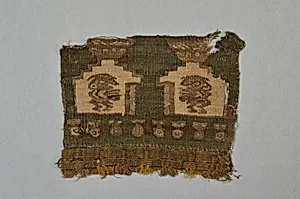
Medium
Camelid hair, cotton
Dimensions
Overall: 4 x 5 in. (10.16 x 12.7 cm) Other: 4 in. (10.16 cm)
Classification
Textiles-Woven
Culture
Lambayeque (Sicán)
Department
Arts of Africa, Oceania, and the Americas
Museum
Metropolitan Museum of Art, New York, NY
Credit
Rogers Fund, 1928
Accession Number
28.64.26
Rights
Public Domain
Art Historical Context
This delicate **Tapestry Fragment** from Lambayeque (Sic) culture of northern Peru, dating to the 9th–13th century, offers a glimpse into pre-Columbian Andean artistry. Measuring just 4 x 5 inches, it was woven from camelid hair—likely from alpacas or vicuñas, prized for their fine, durable fibers—and cotton, a combination that highlights the region's advanced textile traditions. These materials were not only practical for Peru's varied climates but also symbolized wealth and skill, as weaving was a revered craft often dominated by women. The fragment exemplifies **tapestry weaving**, a sophisticated technique where colorful weft threads completely cover the warp, enabling intricate patterns without painting or dyeing after weaving. In Sicán society, such textiles served vital roles in rituals, burials, and trade, conveying cultural narratives through motifs of deities, animals, and geometric designs (though specifics on this piece are preserved only in its weave). This small survivor underscores the Lambayeque's mastery, bridging earlier Moche influences and later Chimú innovations. Acquired through the Rogers Fund in 1928 and housed in the Metropolitan Museum of Art's Department of the Arts of Africa, Oceania, and the Americas, this artifact reminds us how textiles were "portable wealth" in ancient Peru—rivaling gold in prestige. A testament to enduring creativity! (198 words)