
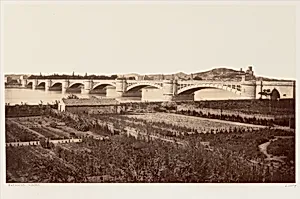
Tarascon, Viaduc
ca. 1861
Medium
Albumen silver print from glass negative
Dimensions
Image: 27 x 44.2 cm (10 5/8 x 17 3/8 in.) Mount: 46 x 60.5 cm (18 1/8 x 23 13/16 in.)
Classification
Photographs
Department
Photographs
Museum
Metropolitan Museum of Art, New York, NY
Credit
Gilman Collection, Gift of The Howard Gilman Foundation, 2005
Accession Number
2005.100.364.34
Rights
Public Domain
Tags
Art Historical Context
Édouard Baldus'sTarascon, Viaduc* (ca. 1861) captures the grandeur of a sweeping railway viaduct in Tarascon, France, the Rhône River valley. As a leading French photographer of the 1850s and 1860s, Baldus was renowned for his documentation of architecture and infrastructure, often commissioned by the to record France's rapidly modernizing landscape during Napoleon III's Second Empire. This image exemplifies his role in Mission Héliographique, blending Romantic sensitivity with documentary rigor to celebrate engineering feats amid dramatic natural scenery. Printed as a large albumen silver print from a glass negative— a cutting-edge technique of the era—the work achieves remarkable clarity and tonal depth, with fine details in the stone arches and distant landscape visible even at its impressive 27 x 44.2 cm scale. Albumen prints, coated with egg whites for sharp resolution, allowed Baldus to produce monumental views that rivaled paintings in impact. Housed in the Metropolitan Museum of Art's Gilman Collection, this photograph bridges art and history, symbolizing France's industrial boom and the era's awe at human ingenuity taming nature. Visitors are drawn into a moment when bridges like this viaduct connected a nation, forever linking progress with picturesque beauty.
About the Artist
Edouard Baldus · 1813–1889
Édouard-Denis Baldus (1813–1889), born in Grünebach, Prussia, moved to Paris in 1838 at age twenty-five to study painting outside the École des Beaux-Arts and atelier system. Trained initially as a painter, draughtsman, and lithographer, he exhibited at the Paris Salons from 1841 to 1851 without notable recognition. Around 1849, Baldus pivoted to photography, embracing William Henry Fox Talbot's p...