
Tatsuta, from the series "Pictures of No Performances (Nogaku Zue)"
1898
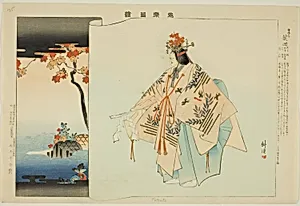
Medium
Color woodblock print
Dimensions
Approx: 25.2 × 37.4 cm (10 × 15 3/8 in.)
Classification
woodblock print
Department
Arts of Asia
Museum
Art Institute of Chicago
Accession Number
155308
Rights
Public Domain
Art Historical Context
Tsukioka Kôgyo’s “Tatsuta,” created in 1898, belongs to his celebrated series “Pictures of Noh Performances” (Nogaku Zue). As a leading printmaker of the Meiji era, Kôgyo devoted much of his career to documenting the graceful, highly stylized world of Noh theater, a classical Japanese dramatic form that blends poetry, music, dance, and masked performance. The print captures a moment from the play “Tatsuta,” evoking the quiet intensity and refined gestures that define this ancient art. Produced as a color woodblock print, the work reflects the enduring vitality of traditional Japanese printmaking at a time when Japan was rapidly modernizing. Multiple carved blocks allowed Kôgyo to layer delicate hues and subtle textures, conveying the rich costumes and atmospheric settings typical of Noh stages. Measuring roughly 25 by 37 centimeters, these intimate sheets were designed for personal appreciation rather than large-scale display. Today in the collection of the Art Institute of Chicago, “Tatsuta” offers viewers a vivid window into Meiji-era efforts to preserve Japan’s cultural heritage. Kôgyo’s sensitive portrayals helped introduce Noh’s poetic beauty to wider audiences, ensuring that the elegance of these performances would be remembered long after the curtain fell.
About the Artist
Tsukioka Kôgyo · 1869–1927
Tsukioka Kōgyo (1869–1927), born Hanyū Bennosuke in Tokyo's bustling Nihonbashi district as the second son of an innkeeper family, navigated a path from humble origins to mastery in Japanese printmaking. After his father's early death, he was raised by his mother's Sakamaki family and apprenticed in pottery painting under his uncle, a ceramics exporter in Yokohama. He briefly attended the Tokyo Sc...