
Taunus Firs
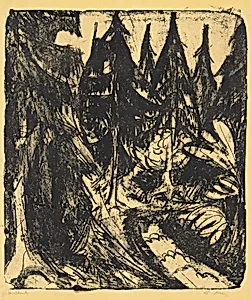
Medium
lithograph on wove yellow paper
Dimensions
sheet: 67 × 53.5 cm (26 3/8 × 21 1/16 in.)
Classification
Department
CG-W
Museum
National Gallery of Art, Washington, D.C.
Credit
Gift of Ruth Cole Kainen
Accession Number
2012.92.739
Rights
Public Domain
Art Historical Context
**Taunus Firs (1916) is a striking lithograph by Ernst Ludwig, a leading figure in German Expressionism and co-founder of the revolutionary Die Brücke group. during the height of World War I—a period of personal turmoil for Kirchner, who struggled with mental health and military service—this print captures the rugged fir trees of the Ta Mountains near Frankfurt. The bold, jagged lines and dynamic composition reflect Expressionism's emphasis on emotional intensity over realistic depiction, evoking the raw power of nature amid human fragility. Printed on warm yellow wove paper (67 × 53.5 cm), the medium enhances the work's vibrant, almost feverish energy. Lithography allowed Kirchner to produce multiples, making his avant-garde vision accessible beyond elite circles—a key innovation for early 20th-century artists. The subtle tonal variations from the paper interact with the inked forms, amplifying the sense of movement and psychological depth. Now in the National Gallery of Art's collection (gift of Ruth Cole Kainen), **Taunus Firs** exemplifies Kirchner's mastery of printmaking and his enduring influence on modern art. Visitors, imagine standing amid these twisted pines—Kirchner invites us to feel the wild pulse of the landscape!
About the Artist
Ernst Ludwig Kirchner · 1880–1938
Ernst Ludwig Kirchner was born on May 6, 1880, in Aschaffenburg, Germany, to parents Ernst and Maria Kirchner, part of a family of Prussian descent that frequently relocated due to his father's career as a chemical technician. After early schooling in various towns, he studied architecture at the Königliche Technische Hochschule (Technical University) in Dresden from 1901 to 1905, taking courses i...