
Taweret amulet
Unknown Artist
664–30 B.C.
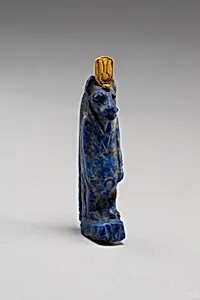
Medium
Lapis lazuli, gold
Dimensions
H. 3.5 cm (1 3/8 in.); W. 0.8 cm (5/16 in.); D. 1.1 cm ( 7/16 in.)
Classification
Amulet, Taweret
Period
Late Period–Ptolemaic Period
Department
Egyptian Art
Museum
Metropolitan Museum of Art, New York, NY
Credit
Theodore M. Davis Collection, Bequest of Theodore M. Davis, 1915
Accession Number
30.8.274
Rights
Public Domain
Tags
Art Historical Context
This exquisite Taweret amulet, from vibrant lapis lazuli inlaid with gold during Egypt's Late Period to Ptolemaic (664–30 B.C.), exemplifies the enduring tradition of protective jewelry in ancient Egyptian culture. Measuring just 3.5 cm high, its petite scale suggests it was worn as a personal talisman, likely suspended from a necklace or bracelet. Lapis lazuli, a stone imported from distant Afghanistan, carried celestial symbolism, while gold evoked the divine flesh of the gods, enhancing the amulet's potency. Taweret, the fierce hippopotamus goddess depicted here, was a beloved protector of women, children, and the home, warding off evil during pregnancy and childbirth. Amulets like this one were ubiquitous in daily life, embodying Egypt's blend of religious devotion and artistry even under Persian and Greek rule in the Late and Ptolemaic Periods. The detailed carving captures her distinctive form—combining hippopotamus bulk, lioness mane, and crocodile tail—in a style true to Egyptian conventions, prioritizing symbolic power over realism. Now part of the Metropolitan Museum of Art's Egyptian Art collection, thanks to the Theodore M. Davis bequest of 1915, this piece offers a window into the intimate spirituality of ancient Egyptians, reminding us how art served as both shield and sacred companion.