
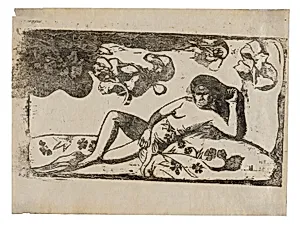
Te arii vahine—opoi (Woman with Mangos—Tired), from the Suite of Late Wood-Block Prints
1898/99
Medium
Wood-block print in black ink on thin ivory Japanese paper, partially laid down on white Japanese paper
Dimensions
Image: 16.5 × 30.5 cm (6 1/2 × 12 1/16 in.); Image with printed edge of block, lower left: 17.1 × 30.5 cm (6 3/4 × 12 1/16 in.); Primary/secondary support: 22.8 × 30.5 cm (9 × 12 1/16 in.)
Classification
woodcut
Department
Prints and Drawings
Museum
Art Institute of Chicago
Accession Number
82569
Rights
Public Domain
Art Historical Context
Paul Gauguin's *Te arii vahine—opoi (Woman with Mangos—T)*, created around 1898–99 during his second stay in Tahiti, captures the artist's fascination with Polynesian life. Part of his *Suite of Late Wood-Block Prints*, this work depicts a noble Tahitian woman resting wearily with mangoes, blending exoticism and introspection. Gauguin, a Post-Impressionist, sought escape from European civilization in the South Seas, infusing his art with symbolic, flattened forms and vibrant cultural motifs inspired by his surroundings. Printed in black ink on delicate thin ivory Japanese paper—partially laid down on white Japanese paper—this woodcut exemplifies Gauguin's bold experimentation with the medium. Influenced by ukiyo-e masters like Hokusai, he hand-carved the blocks himself, achieving rough, expressive lines that evoke primitive power and texture. The modest dimensions (image: 16.5 × 30.5 cm) highlight its intimate, printmaker's scale, contrasting his larger paintings. Housed in the Art Institute of Chicago's Prints and Drawings department, this piece underscores Gauguin's innovative printmaking, bridging Japanese techniques with Tahitian themes. It reveals his quest for authenticity amid personal hardship, offering visitors a window into his late, feverish creativity before his death in 1903.
About the Artist
Paul Gauguin · 1848–1903
Paul Gauguin (1848-1903) was a French Post-Impressionist painter whose bold experiments with color, form, and subject matter made him one of the most influential figures in the transition from 19th-century art to modernism. His rejection of European civilization for the perceived authenticity of 'primitive' cultures established an archetype of artistic exile that continues to resonate. Gauguin's ...