
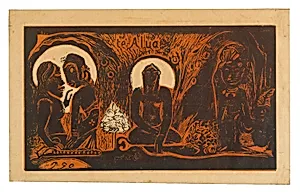
Te atua (The God), from the Noa Noa Suite
1894
Medium
Wood-block print in black ink, over a stenciled dark-red-ink tone block, on cream wove paper (an imitation Japanese vellum)
Dimensions
Image: 20.6 × 35.7 cm (8 1/8 × 14 1/16 in.); Sheet: 24.7 × 39.7 cm (9 3/4 × 15 11/16 in.)
Classification
woodcut
Department
Prints and Drawings
Museum
Art Institute of Chicago
Accession Number
47171
Rights
Public Domain
Art Historical Context
Paul Gauguin's *Te atua (The God, created in 1894, is a striking woodcut from his *Noa Noa* suite, inspired by the artist's transformative journey to Tahiti. Seeking escape from modern European society, Gauguin immersed in Polynesian culture, capturing its myths and spirituality in vivid, symbolic imagery. The title, translating to "The God" in Tahitian, evokes island's ancient deities, reflecting Gauguin's fascination with exoticism and primitivism—a hallmark of his Post-Impression style that rejected realism for bold, flattened forms and emotional depth. This print showcases Gauguin's innovative adaptation of Japanese ukiyo-e techniques, using a wood-block in black ink layered over a stenciled dark-red tone block on cream wove paper mimicking Japanese vellum. Measuring just 20.6 × 35.7 cm, its intimate scale invites close viewing, where rough-hewn lines and stark contrasts mimic carved wood idols, blending Western printmaking with Eastern influences. Housed in the Art Institute of Chicago's Prints and Drawings department, it exemplifies Gauguin's experimental printmaking during a pivotal period, bridging his paintings and the broader Symbolist movement. A window into his quest for a "savage" paradise, this work continues to captivate with its raw power and cultural fusion.
About the Artist
Paul Gauguin · 1848–1903
Paul Gauguin (1848-1903) was a French Post-Impressionist painter whose bold experiments with color, form, and subject matter made him one of the most influential figures in the transition from 19th-century art to modernism. His rejection of European civilization for the perceived authenticity of 'primitive' cultures established an archetype of artistic exile that continues to resonate. Gauguin's ...