
Te atua (The God), from the Suite of Late Wood-Block Prints
1898/99
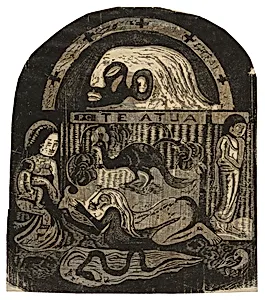
Medium
Second-state impression laid down on first-state impression Wood-block print of second state in black ink on lunette-shaped, thin ivory Japanese paper, laid down on wood-block print of first state in brownish-black ink on lunette-shaped ivory wove paper
Dimensions
Image/primary/secondary support: 23.1 × 20.2 cm (9 1/8 × 8 in.)
Classification
woodcut
Department
Prints and Drawings
Museum
Art Institute of Chicago
Accession Number
44782
Rights
Public Domain
Art Historical Context
Paul Gauguin's *Te atua (The God)*, created around 1898–99, captures the artist's immersion in Tahitian culture during his second stay on the island. Part of his *Suite of Late Wood-B Prints*, this work reflects Gauguin's fascination with Polynesian mythology and. "Te atua," meaning "The God" in Maori, likely evokes ancient idols and rituals, blending exoticism with Post-Impressionist boldness. Gauguin, seeking escape from Western civilization, produced these prints amid financial hardship and illness, using rudimentary tools to channel a raw, primal aesthetic inspired by Japanese ukiyo-e and folk art. This woodcut stands out for its innovative technique: a second-state impression in black ink on thin, lunette-shaped ivory Japanese paper, laid directly onto a first-state print in brownish-black ink on wove paper. Measuring just 23.1 × 20.2 cm, this layered composition reveals Gauguin's experimental process—overprinting states to build texture and depth. Housed in the Art Institute of Chicago's Prints and Drawings department, it exemplifies his shift from oil painting to printmaking, prioritizing emotional intensity over refined detail. For visitors, *Te atua* offers a window into Gauguin's quest for the "primitive," challenging European norms while celebrating Oceanic heritage—though his romanticized gaze has sparked modern debates on cultural appropriation. A testament to artistic reinvention, it invites contemplation of divinity and the artist's inner world.
About the Artist
Paul Gauguin · 1848–1903
Paul Gauguin (1848-1903) was a French Post-Impressionist painter whose bold experiments with color, form, and subject matter made him one of the most influential figures in the transition from 19th-century art to modernism. His rejection of European civilization for the perceived authenticity of 'primitive' cultures established an archetype of artistic exile that continues to resonate. Gauguin's ...