
Te faruru (Here We Make Love), from the Noa Noa Suite
1893/94
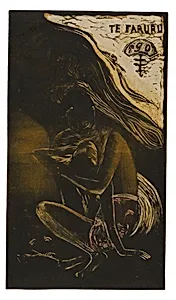
Medium
Wood-block print, printed twice in golden-brown and black inks, with selective wiping of the black ink, over a selectively inked yellow tone block, and transferred deep-yellow, red, and orange oil-based media, some containing beeswax and conifer resin (probably pine resin), with hand-applied dark yellow and brown gouache, on cream Japanese paper (previously mounted on mottled blue wove paper laid down on cream wove card [a presentation mount])
Dimensions
Image/sheet: 35.7 × 20.5 cm (14 1/16 × 8 1/8 in.)
Classification
woodcut
Department
Prints and Drawings
Museum
Art Institute of Chicago
Accession Number
68508
Rights
Public Domain
Art Historical Context
Paul Gauguin's *Te faruru (Here Make Love)*, created around 1893–94, is a striking woodcut from his *Noa Noa* suite, inspired by his transformative journey to Tahiti in 1891. Seeking escape from modern European society, Gauguin immersed himself in Polynesian culture documenting his experiences in a journal titled *Noa Noa* ("Fragrant"). This print captures an intimate, erotic moment between lovers amid lush tropical motifs, embodying his fascination with exoticism and primal sensuality. As a Post-Impressionist pioneer, Gauguin rejected realism for bold colors, flattened forms, and symbolic narratives, influencing later movements like Primitivism. What sets this work apart is Gauguin's experimental printmaking technique. Printed from multiple woodblocks in golden-brown and black inks, with selective wiping to create texture, it layers a yellow tone block, vibrant oil-based media in deep yellow, red, and orange (mixed with beeswax and pine resin for luminosity), and hand-applied gouache. On cream Japanese paper—evoking Eastern influences—this complex process mimics painting's richness in a print medium, showcasing Gauguin's innovative push beyond traditional woodcuts. Housed in the Art Institute of Chicago's Prints and Drawings Department, this 35.7 × 20.5 cm piece highlights Gauguin's blend of Western technique and Tahitian inspiration, offering visitors a window into his quest for artistic paradise. Its sensual title and execution invite reflection on cultural encounter and desire.
About the Artist
Paul Gauguin · 1848–1903
Paul Gauguin (1848-1903) was a French Post-Impressionist painter whose bold experiments with color, form, and subject matter made him one of the most influential figures in the transition from 19th-century art to modernism. His rejection of European civilization for the perceived authenticity of 'primitive' cultures established an archetype of artistic exile that continues to resonate. Gauguin's ...