
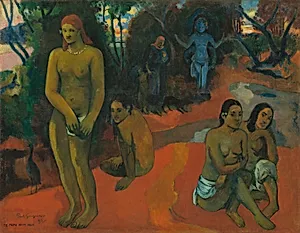
Te Pape Nave Nave (Delectable Waters)
1898
Medium
oil on canvas
Dimensions
overall: 74 × 95.3 cm (29 1/8 × 37 1/2 in.) framed: 90.8 × 111.4 × 7.62 cm (35 3/4 × 43 7/8 × 3 in.)
Classification
Painting
Department
CF
Museum
National Gallery of Art, Washington, D.C.
Credit
Collection of Mr. and Mrs. Paul Mellon
Accession Number
1973.68.2
Rights
Public Domain
Art Historical Context
Paul Gauguin’sTe Pape Nave Nave (lectable Waters)* painted in 1898 captures the artist’s deep fascination with Tahitian life during his second stay in the South Pacific. Working in oil on canvas, Gauguin used rich, saturated colors and simplified forms to evoke an imagined paradise far removed from the world of Europe. The, drawn from theitian language, hints at sensual and tranquil qualities he sought to celebrate in his depictions of island waters and figures. This work belongs to Gauguin’s late period, when he turned increasingly toward Symbolist ideas, using color and composition not merely record what he saw but to suggest mood, mystery, and spiritual harmony. His flattened planes and decorative patterns reflect both his admiration for non-Western art and his desire to create a new visual language. Today the painting invites viewers to consider questions of cultural encounter and artistic invention that remain relevant more than a century later.
About the Artist
Paul Gauguin · 1848–1903
Paul Gauguin (1848-1903) was a French Post-Impressionist painter whose bold experiments with color, form, and subject matter made him one of the most influential figures in the transition from 19th-century art to modernism. His rejection of European civilization for the perceived authenticity of 'primitive' cultures established an archetype of artistic exile that continues to resonate. Gauguin's ...