
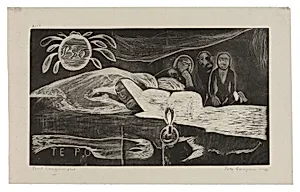
Te po (The Night), from the Noa Noa Suite
1893–94, printed and published 1921
Medium
Wood-block print in black ink on grayish-ivory China paper
Dimensions
Image: 20.4 × 35.8 cm (8 1/16 × 14 1/8 in.); Sheet: 26.6 × 42.5 cm (10 1/2 × 16 3/4 in.)
Classification
woodcut
Department
Prints and Drawings
Museum
Art Institute of Chicago
Accession Number
14326
Rights
Public Domain
Art Historical Context
Paul Gauguin created *Te po (The Night)* as part of his Noa Noa suite, a series of woodcuts inspired by his travels to Tahiti in the early 1890s. The title, drawn from the Tahitian language, evokes the mysterious, spiritual atmosphere of the South Pacific nights that captivated the artist. Created between 1893 and 1894, these prints reflect Gauguin’s deep fascination with Polynesian culture and his desire to escape the conventions of European art. Executed as a wood-block print in black ink on delicate China paper, the work showcases the bold, simplified forms and rhythmic patterns characteristic of Gauguin’s printmaking. The woodcut medium allowed him to emphasize strong contours and flattened space, evoking the feel of ancient carved objects and aligning with his interest in so-called “primitive” art. Though printed during his lifetime, this impression was published posthumously in 1921, helping to introduce his Tahitian vision to wider audiences. Today, *Te po* stands as a powerful example of Gauguin’s Synthetist approach, blending observed reality with symbolic meaning. It invites viewers to consider themes of mystery, nature, and cultural encounter that remain central to discussions of Post-Impressionism and early modern printmaking.
About the Artist
Paul Gauguin · 1848–1903
Paul Gauguin (1848-1903) was a French Post-Impressionist painter whose bold experiments with color, form, and subject matter made him one of the most influential figures in the transition from 19th-century art to modernism. His rejection of European civilization for the perceived authenticity of 'primitive' cultures established an archetype of artistic exile that continues to resonate. Gauguin's ...