
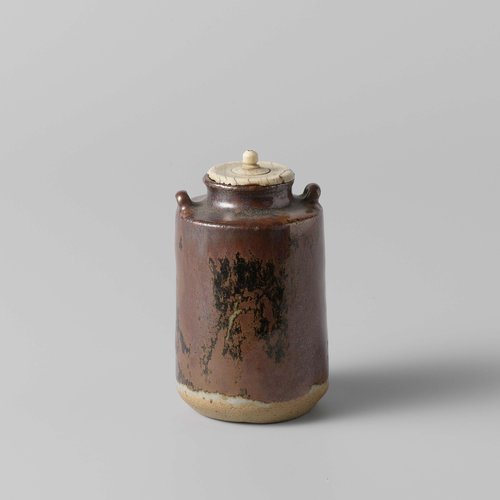
Tea caddy with a brown black glaze and two handles
ca. 1775 - ca. 1824
Medium
turning
Dimensions
5.1; 8.7
Rights
Public Domain
About this artwork
…; collection of Herman Karel Westendorp (1868-1941), Amsterdam, 1941;{Note RMA.} his widow Betsy Westendorp-Osieck (1880-1968), Amsterdam, by whom bequeathed to the Vereniging van Vrienden der Aziatische Kunst, 1968;{note RMA.} from whom on loan to the museum, 1972
Art Historical Context
This delicate tea caddy, standing just 8.7 cm high and 5.1 cm in diameter, exemplifies everyday elegance from the late 18th early 19th centuryca. 1775–1824). Crafted anonymously, its compact form with two sturdy handles and a rich brown-black glaze was designed to store precious tea leaves—a luxury commodity that fueled global trade and social rituals during this era. Such caddies were essential in households where tea drinking bridged Asian traditions and European refinement, highlighting the object's role in cross-cultural exchange. The medium of "turning" refers to the skilled lathe-based technique, often used in ceramics to achieve precise, symmetrical shapes with a smooth finish. The glossy brown-black glaze not only protected the vessel but also lent it a sophisticated, almost metallic sheen, evoking the earthy tones prized in East Asian pottery. Though the artist remains unknown, this piece reflects the masterful anonymity of workshop traditions, where functionality met subtle artistry. Acquired through the esteemed collection of Dutch connoisseur Herman Karel Westendorp (1868–1941) and later bequeathed by his widow Betsy Westendorp-Osieck, it entered the Vereniging van Vrienden der Aziatische Kunst in 1968 and has been on loan to the museum since 1972. Today, it invites us to ponder the quiet beauty of utilitarian objects that carried the aroma of distant lands.