
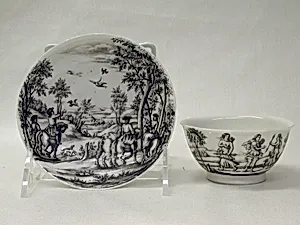
Teabowl and saucer
Medium
Hard-paste porcelain
Dimensions
Overall (teabowl .2): 1 11/16 × 3 3/16 in. (4.3 × 8.1 cm); Diameter (saucer .3): 4 1/2 in. (11.4 cm)
Classification
Ceramics-Porcelain
Culture
German, Meissen
Department
European Sculpture and Decorative Arts
Museum
Metropolitan Museum of Art, New York, NY
Credit
Rogers Fund, 1940
Accession Number
40.69.2, .3
Rights
Public Domain
Tags
Art Historical Context
This exquisite teabowl and sa from the Meissen Manufactory's Böttger Period (. 1715–20) represents a triumph of early European porcelain innovation. Produced at the Saxony-based factory founded in 1710 by Augustus the Strong, Elector of Saxony, it exemplifies hard-paste porcelain—the first true European equivalent to coveted Chinese kaolin-based wares. Decorator Ignaz Preissler likely the delicate overglaze enamel scenes featuring horses, men, and trees,oking pastoral or equestrian motifs popular in Rococo-era decorative arts. The Böttger Period honors Johann Friedrich Böttger, the alchemist-turned-ceramist who unlocked the secret formula for hard-paste porcelain in 1708 after years of experimentation under royal patronage. This breakthrough ended Europe's dependence on Asian imports, fueling a luxury boom in tableware amid the rising fashion for tea drinking among the elite. Meissen's translucent, resonant porcelain, fired at high temperatures, allowed for intricate painting that withstood daily use, blending technical mastery with artistic flair. Housed in The Metropolitan Museum of Art's European Sculpture and Decorative Arts collection (Rogers Fund, 1940), this diminutive set (teabowl: 1 11/16 × 3 3/16 in.; saucer diameter: 4 1/2 in.) captures the era's cultural fusion: German ingenuity meets Oriental inspiration, making it a gem for admirers of 18th-century elegance.
About the Artist
Meissen Manufactory|Böttger Period|Ignaz Preissler · 1710–present
The Meissen Manufactory, established on June 6, 1710, by Augustus the Strong, Elector of Saxony and King of Poland, marked the dawn of true hard-paste porcelain production in Europe. Nestled at Albrechtsburg Castle in Meissen near Dresden, the Royal Polish and Electoral Saxon Porcelain Manufactory arose from alchemical experiments begun in 1708 by physicist Ehrenfried Walther von Tschirnhaus and p...