
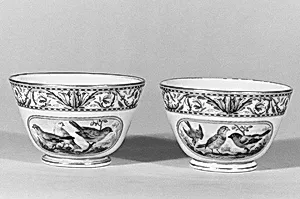
Teacup (part of a service)
ca. 1780–85
Medium
Hard-paste porcelain
Dimensions
Height: 2 in. (5.1 cm)
Classification
Ceramics-Porcelain
Culture
German, Meissen
Department
European Sculpture and Decorative Arts
Museum
Metropolitan Museum of Art, New York, NY
Credit
The Lesley and Emma Sheafer Collection, Bequest of Emma A. Sheafer, 1973
Accession Number
1974.356.472
Rights
Public Domain
Tags
Art Historical Context
This exquisite teacup, part of a porcelain tea service from the Meissenufactory during the Marcolini Periodca. 1780–85), captures the elegance of late 18th-century German craftsmanship. Standing just 2 inches tall and made of hard-paste—a durable, translucent material that revolutionized European ceramics by mimicking prized Chinese imports—Meissen's pieces like this were luxury goods for the aristocracy. Delicately painted birds adorn its surface, a hallmark motif showcasing the factory's mastery of fine enamel techniques. Founded in 1710 near Dresden, Meissen was Europe's pioneer in hard-paste porcelain production, guarded by state secrets to maintain supremacy. Under director Carlo Marcolini (1774–1811), the manufactory shifted toward neoclassical restraint, emphasizing naturalistic details, subtle gilding, and precise modeling over earlier exuberance. These services symbolized refined taste and hospitality in Enlightenment-era salons. Today, housed in The Metropolitan Museum of Art's European Sculpture and Decorative Arts department as part of The Lesley and Emma Sheafer Collection, this teacup highlights porcelain's role in cultural prestige and technical innovation, bridging art and everyday ritual with timeless charm.
About the Artist
Meissen Manufactory|Marcolini Period · 1710–present
The Meissen Manufactory, established on June 6, 1710, by Augustus the Strong, Elector of Saxony and King of Poland, marked the dawn of true hard-paste porcelain production in Europe. Nestled at Albrechtsburg Castle in Meissen near Dresden, the Royal Polish and Electoral Saxon Porcelain Manufactory arose from alchemical experiments begun in 1708 by physicist Ehrenfried Walther von Tschirnhaus and p...