
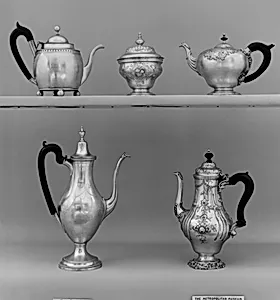
Teapot
Unknown Artist
18th century
Medium
Silver
Dimensions
Height: 7 1/2 in. (19.1 cm)
Classification
Metalwork-Silver
Culture
Portuguese
Department
European Sculpture and Decorative Arts
Museum
Metropolitan Museum of Art, New York, NY
Credit
Rogers Fund, 1912
Accession Number
12.124.20
Rights
Public Domain
Tags
Art Historical Context
This elegant 18th-century Portuguese teapot, standing at a dainty 7 1/2 inches tall, exemplifies the refined metalwork of Europe's decorative arts tradition. Crafted by an artist, its compact form and shimmering surface highlight the era's mastery of silversmithing, where skilled artisans shaped precious metal into functional yet luxurious objects for the elite. Housed in the Metropolitan Museum of Art's Department of European Sculpture and Decor Arts, it entered the collection through the Rogers Fund in 2. In the context of 18th-century Portugal—a nation buoyed by its vast colonial empire and trade networks—such teapots symbolized sophistication and hospitality. Tea drinking surged in popularity across Europe during this Enlightenment period, transforming everyday rituals into displays of status. The teapot's floral motifs, a common tag for this piece, likely feature chased or engraved blossoms, evoking the Baroque and Rococo influences that favored nature-inspired ornamentation for whimsy and abundance. As a prime example of Portuguese silverwork, this teapot invites us to appreciate the interplay of utility and artistry: its spout and handle designed for graceful pouring, its surface polished to a mirror-like gleam. Though anonymous, the maker's technique endures, offering a tangible link to a vibrant chapter of European craftsmanship.