
Teapot
ca. 1740
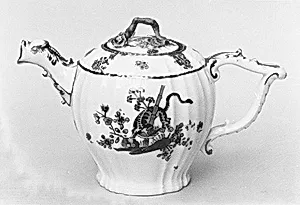
Medium
Hard-paste porcelain
Dimensions
3 1/2 × 5 3/4 in. (8.9 × 14.6 cm)
Classification
Ceramics-Porcelain
Culture
German, Meissen
Department
European Sculpture and Decorative Arts
Museum
Metropolitan Museum of Art, New York, NY
Credit
The George B. McClellan Collection, Gift of Mrs. George B. McClellan, 1941
Accession Number
42.205.130a, b
Rights
Public Domain
Tags
Art Historical Context
This elegant teapot from the Meissenufactory, dating to around 1740, exemplifies pinnacle of early European porcelain production. Meissen, established in 1710 near Dresden, Germany, was the first factory to successfully replicate Chinese hard-paste porcelain—a translucent, durable material fired at high temperatures that allowed for intricate modeling and vibrant decoration. Adorned with delicate motifs animals and flowers, this vessel (just 3½ × 5¾ inches) reflects the Rococo taste for playful naturalism and opulence during the 18th century. The teapot's significance lies in its role as a luxury good for Europe's aristocracy, symbolizing technical mastery and cultural sophistication. Meissen's crossed swords mark, often incised underneath, became a hallmark of authenticity amid widespread fakes. Painstaking hand-painted enamels and gilding brought the porcelain to life, capturing the era's fascination with exotic chinoiserie influences blended with European whimsy. Housed in the Metropolitan Museum of Art's European Sculpture and Decorative Arts department, this piece from the George B. McClellan Collection invites us to appreciate how everyday objects became canvases for artistic innovation, bridging functionality and fine art.
About the Artist
Meissen Manufactory · 1710–present
The Meissen Manufactory, established on June 6, 1710, by Augustus the Strong, Elector of Saxony and King of Poland, marked the dawn of true hard-paste porcelain production in Europe. Nestled at Albrechtsburg Castle in Meissen near Dresden, the Royal Polish and Electoral Saxon Porcelain Manufactory arose from alchemical experiments begun in 1708 by physicist Ehrenfried Walther von Tschirnhaus and p...