
Teapot
ca. 1760
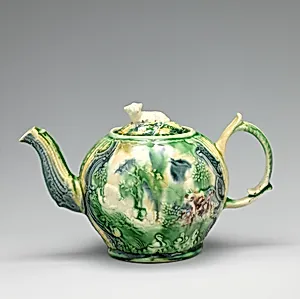
Medium
Lead-glazed earthenware
Dimensions
Height: 4 3/4 in. (12.1 cm)
Classification
Ceramics-Pottery
Culture
British, Staffordshire
Department
European Sculpture and Decorative Arts
Museum
Metropolitan Museum of Art, New York, NY
Credit
Gift of Mrs. Russell S. Carter, 1944
Accession Number
44.39.32a, b
Rights
Public Domain
Art Historical Context
This charming teapot, crafted around 1760 in the Staffordshire region of Britain, reflects the growing popularity of tea drinking among the middle classes during the Georgian era. Staffordshire had become England’s premier center for pottery production, and pieces labeled “Whieldon type” evoke the inventive spirit of Thomas Whieldon, whose workshop pioneered colorful, affordable earthenware that rivaled imported porcelain. Standing just under five inches tall, the vessel would have been both practical and decorative on a tea table of the period. The lead-glazed earthenware technique allowed potters to achieve rich, mottled surfaces—often tortoiseshell-like in appearance—while remaining sturdy enough for everyday use. Fired at relatively low temperatures, these glazes produced a warm, glossy finish that highlighted the teapot’s simple, elegant form. Such objects bridged the gap between luxury imports and mass-produced goods, making refined tea rituals accessible beyond aristocratic circles. Today, this example in the Metropolitan Museum’s collection reminds visitors how everyday ceramics shaped social customs and industrial innovation in eighteenth-century Britain. Its modest scale and refined glaze continue to speak to the artistry embedded in functional household wares.
About the Artist
Whieldon type
Whieldon-type is not a single artist but a catalogue attribution used by museums for unmarked mid-18th-century Staffordshire earthenware in the manner of Thomas Whieldon (1719-1795), the celebrated English potter of Fenton Vivian. Whieldon perfected lead-glazed cream-colored earthenware streaked and dappled with metallic oxides - manganese browns, copper greens, cobalt blues - producing the mottle...