
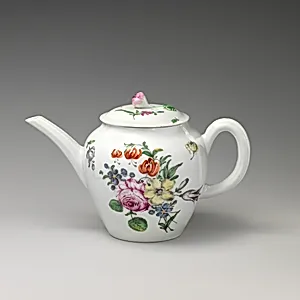
Teapot
18th century
Medium
Soft-paste porcelain
Dimensions
confirmed: 5 3/16 × 8 3/16 × 4 1/2 in. (13.2 × 20.8 × 11.4 cm)
Classification
Ceramics-Porcelain
Culture
British, Worcester
Department
European Sculpture and Decorative Arts
Museum
Metropolitan Museum of Art, New York, NY
Credit
Gift of Mrs. Constance D. Stieglitz, in memory of her husband, Marcel H. Stieglitz, 1964
Accession Number
64.142.26a, b
Rights
Public Domain
Tags
Art Historical Context
This elegant teapot, crafted by the renowned Worcester factory in 18th-century Britain, exemplifies the golden age of English porcelain production. Made from soft-paste porcelain—a mixture of clay and ground glass fired at lower temperatures than true hard-paste—this medium allowed factories like Worcester to create delicate, translucent wares that rivaled expensive Chinese imports. Measuring 5 3/16 × 8 3/16 × 4 1/2 inches, its graceful form was designed for the burgeoning tea-drinking ritual that swept through British society, symbolizing refinement and hospitality. Worcester, established in 1751, became a leader in the industry, pioneering techniques like underglaze transfer-printing to decorate everyday luxury items affordably. Adorned with vibrant motifs of roses, flowers, and leaves—hallmarks of English floral designs—this teapot reflects the era's obsession with nature-inspired patterns, blending botanical accuracy with Rococo whimsy. These decorations not only enhanced its aesthetic appeal but also underscored porcelain's role as a canvas for cultural expression during the Enlightenment. Today, housed in the Metropolitan Museum of Art's European Sculpture and Decorative Arts department, this gift from Mrs. Constance D. Stieglitz honors a legacy of craftsmanship that made fine ceramics accessible to the growing middle class, bridging art and daily life.
About the Artist
Worcester factory · 1751–2008
The Worcester porcelain factory, established in 1751 in Worcester, England, by physician Dr. John Wall and apothecary William Davis along with 14 partners, marked the birth of one of Britain's most enduring ceramic enterprises. Investing £4,500 at Warmstry House on the River Severn, the founders drew on contacts with the Bristol porcelain manufactory to develop a novel soft-paste porcelain using s...