
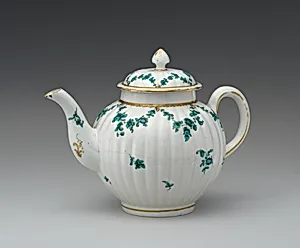
Medium
Soft-paste porcelain
Dimensions
Height: 6 1/4 in. (15.9 cm)
Classification
Ceramics-Porcelain
Culture
British, Chelsea-Derby
Department
European Sculpture and Decorative Arts
Museum
Metropolitan Museum of Art, New York, NY
Credit
Museum Accession
Accession Number
X.3.25a, b
Rights
Public Domain
Tags
Art Historical Context
This charming teapot, crafted around 1775 by the Chelsea Por Manufactory in collaboration with Derby Porcelain Manufactory, exemplifies the pinnacle of British soft-paste porcelain during the-Derby period. at 6 1/4 inches tall, its delicate form reflects the era's obsession with refined tableware, blending functionality with artistry. Soft-paste porcelain, a British innovation using a mixture of white clay, ground glass, and soapstone, allowed factories like Chelsea and Derby to mimic the translucent glow of coveted Chinese hard-paste porcelain developing their own vibrant styles. The Chelsea-Derby partnership, formed after Derby acquired Chelsea in 1770, marked a golden age for English ceramics, producing pieces prized by aristocracy and collectors alike. Adorned with floral motifs—a hallmark of the period—this teapot showcases meticulous hand-painted enameling over glaze, a technique that ensured durability and brilliance. Such wares were not just vessels but status symbols, embodying the rococo influences of lavish gilding and naturalistic flowers. In 18th-century Britain, amid the booming tea trade from China, teapots like this fueled social rituals in drawing rooms, symbolizing hospitality and sophistication. Today, at the Metropolitan Museum of Art, it invites us to appreciate the fusion of commerce, craftsmanship, and culture that defined Georgian elegance.
About the Artist
Chelsea Porcelain Manufactory|Derby Porcelain Manufactory · 1744–1784
**Chelsea Porcelain Manufactory** The Chelsea Porcelain Manufactory, Britain's pioneering porcelain enterprise, was founded around 1743 in Chelsea, London, by two Huguenot silversmiths: Nicholas Sprimont from Liège and Charles Gouyn. Sprimont, trained in Paris as a goldsmith before immigrating to England, brought his expertise in luxury metalwork to the venture, while Gouyn handled early sales th...