
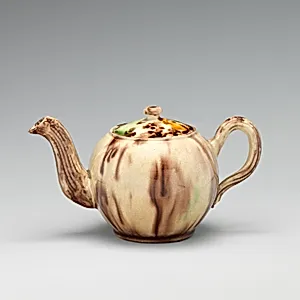
Teapot with cover
mid-18th century
Medium
Lead-glazed earthenware
Dimensions
Height: 2 7/8 in. (7.3 cm)
Classification
Ceramics-Pottery
Culture
probably British, Staffordshire
Department
European Sculpture and Decorative Arts
Museum
Metropolitan Museum of Art, New York, NY
Credit
Frederick C. Hewitt Fund, 1911
Accession Number
11.133.7a, b
Rights
Public Domain
Art Historical Context
This charming mid-18th-century teapot with cover, attributed to the Whieldon type, reflects the vibrant ceramic traditions of Staffordshire, England. During this period, tea drinking had become a fashionable social ritual across Britain, spurring potters to create affordable yet decorative wares for the growing middle class. Staffordshire workshops, centered in the heart of England’s pottery industry, specialized in lead-glazed earthenware that offered both practicality and visual appeal. Thomas Whieldon, after whom this style is named, was renowned for his innovative glazing techniques, including the popular tortoiseshell effect achieved by applying metallic oxides beneath a clear lead glaze. These methods produced rich, mottled colors that elevated everyday objects like teapots into small works of art. The compact size of this example—just under three inches tall—suggests it may have been designed for personal use or as a refined accessory in a tea service. Acquired by the Metropolitan Museum of Art in 1911 through the Frederick C. Hewitt Fund, the piece exemplifies how British ceramics bridged utility and ornament during the Georgian era. Its simple yet elegant form highlights the technical skill of Staffordshire potters who helped transform pottery into a respected decorative art.
About the Artist
Whieldon type
Whieldon-type is not a single artist but a catalogue attribution used by museums for unmarked mid-18th-century Staffordshire earthenware in the manner of Thomas Whieldon (1719-1795), the celebrated English potter of Fenton Vivian. Whieldon perfected lead-glazed cream-colored earthenware streaked and dappled with metallic oxides - manganese browns, copper greens, cobalt blues - producing the mottle...