
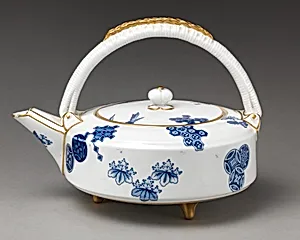
Teapot with fixed handle
1870s
Medium
Bone china
Dimensions
confirmed: 6 5/16 × 8 1/4 × 6 1/2 in. (16 × 21 × 16.5 cm)
Classification
Ceramics-Porcelain
Culture
British, Worcester
Department
European Sculpture and Decorative Arts
Museum
Metropolitan Museum of Art, New York, NY
Credit
Gift of Helene Fortunoff and Robert Grossman, 2017
Accession Number
2018.62.87a, b
Rights
Public Domain
Art Historical Context
Step into the refined world of Victorian Britain with this charming *Teapot with fixed handle*, crafted by the renowned Worcester factory in the 1870s. Produced from bone china—a prized British innovation blending bone ash, china stone, and clay for exceptional translucency, strength, pure white finish—this teapot exemplifies the height of 19th-century ceramic artistry. Measuring 6 5/16 × 8 1/4 × 6 1/2 inches, its practical yet elegant form, complete with a sturdy fixed handle, was designed for the daily ritual of tea drinking, a cornerstone of British social life. Worcester Porcelain Works, established in 1751, became a leader in high-quality tableware, rivaling elite European makers like Sèvres and Meissen. By the 1870s, amid the Industrial Revolution's boom, factories like Worcester mass-produced sophisticated bone china for middle-class homes, turning everyday objects into symbols of refinement and hospitality. This piece highlights the era's technical mastery in porcelain firing and molding, where even subtle curves and handles demanded precision to avoid cracks. Today, housed in the Metropolitan Museum of Art's European Sculpture and Decorative Arts department as a 2017 gift from Helene Fortunoff and Robert Grossman, it invites us to savor the cultural elegance of Victorian tea culture—a blend of innovation, tradition, and quiet luxury.
About the Artist
Worcester factory · 1751–2008
The Worcester porcelain factory, established in 1751 in Worcester, England, by physician Dr. John Wall and apothecary William Davis along with 14 partners, marked the birth of one of Britain's most enduring ceramic enterprises. Investing £4,500 at Warmstry House on the River Severn, the founders drew on contacts with the Bristol porcelain manufactory to develop a novel soft-paste porcelain using s...