
Teapot with landscape
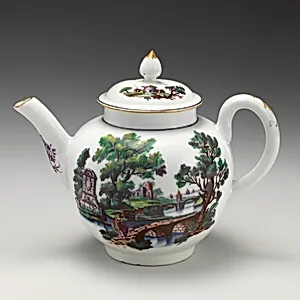
Medium
Soft-paste porcelain with transfer-printed decoration
Dimensions
Height (with cover): 5 5/8 in. (14.3 cm)
Classification
Ceramics-Porcelain
Culture
British, Worcester
Department
European Sculpture and Decorative Arts
Museum
Metropolitan Museum of Art, New York, NY
Credit
Gift of Mr. and Mrs. Luke Vincent Lockwood, 1939
Accession Number
39.140.35a, b
Rights
Public Domain
Tags
Art Historical Context
This elegant teapot, crafted by the renowned Worcester porcelain factory around 1770, exemplifies the of British ceramic innovation during the 18th century. Made from soft-paste porcelain—a, European-developed alternative to true Chinese porcelain—the piece features transfer-printed decoration, a groundbreaking technique that allowed intricate designs to be mass-applied via engraved copper plates. The landscape scene, likely inspired by engravings from French-born artist François Vivares and Antoine Patel the Younger, depicts bridges and figures of men, evoking pastoral English countryside vistas popular in Georgian-era tableware. Worcester, a leading factory from the 1750s onward, pioneered transfer-printing on porcelain, making luxury goods more accessible to the growing middle class amid the rise of tea culture. Standing just 5⅝ inches tall with its cover, this teapot was both functional and ornamental, blending utility with artistic refinement in the European decorative arts tradition. Today, housed in the Metropolitan Museum of Art's Department of European Sculpture and Decorative Arts (gift of Mr. and Mrs. Luke Vincent Lockwood, 1939), it highlights how British manufacturers adapted Continental engraving styles to compete with imported Chinese porcelain, symbolizing the era's blend of commerce, craftsmanship, and cultural exchange.
About the Artist
Worcester factory|François Vivares|Pierre Antoine Patel the Younger · 1751–2008
The Worcester porcelain factory, established in 1751 in Worcester, England, by physician Dr. John Wall and apothecary William Davis along with 14 partners, marked the birth of one of Britain's most enduring ceramic enterprises. Investing £4,500 at Warmstry House on the River Severn, the founders drew on contacts with the Bristol porcelain manufactory to develop a novel soft-paste porcelain using s...