
Teheran
1858
Medium
Salted paper print from paper negative
Classification
Photographs
Department
Photographs
Museum
Metropolitan Museum of Art, New York, NY
Credit
Gift of Kay Gregory, 1967
Accession Number
67.606.5
Rights
Public Domain
Tags
Art Historical Context
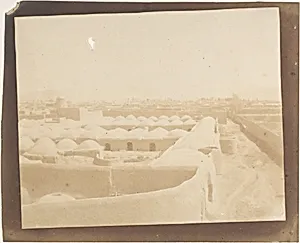
**Teheran, 1858** Captured by Italian photographer Luigi Pesce, *Teheran* is a salted paper print made from a paper negative, one of the earliest photographic glimpses of Iran's capital city during the Qajar dynasty. Pesce, a naval officer and avid traveler, ventured through the Middle East in the late 1850s, exotic locales with the pioneering tools of photography. This image likely depicts the bustling townscape of Tehran—a gateway to Persian culture—with its mud-brick architecture, minarets, and vibrant street life, offering 19th-century Western viewers a rare window into a distant world. The salted paper process, popularized by William Henry Fox Talbot's calotype in the 1840s, was revolutionary for its time. It involved sensitizing paper with salt and silver nitrate, creating soft, matte prints with subtle tonal gradations that mimicked drawings or paintings. Though prone to fading, these prints preserved fleeting moments with an intimate, handcrafted quality, distinguishing them from sharper glass-plate methods. Pesce's work exemplifies early travel photography's role in bridging cultures and fueling Orientalist fascination. Today, housed in the Metropolitan Museum of Art thanks to a 1967 gift from Kay Gregory, *Teheran* highlights photography's power to freeze history. It invites us to ponder a Tehran on the cusp of modernization, where tradition met emerging technology. (198 words)
About the Artist
Luigi Pesce · 1818–1891
**Luigi Pesce (1828–1864)** was an Italian colonel and pioneering amateur photographer from Naples in the Kingdom of the Two Sicilies, whose work captured some of the earliest images of Iran's ancient monuments and 19th-century life. Arriving in Persia in 1848 during the reign of Naser al-Din Shah Qajar, Pesce was tasked with training Iranian infantry units, a mission that positioned him ideally t...