
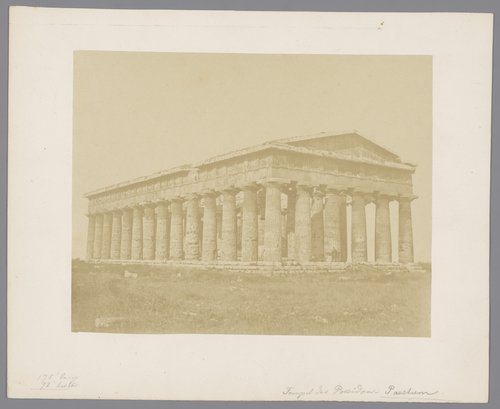
Tempel van Juno te Paestum
1857 - 1914
Medium
albumen print
Dimensions
239; 220; 172; 294
Rights
Public Domain
About this artwork
albuminedruk
Art Historical Context
Behold the *Tempel van Juno te Paestum*, a captivating albumen print by Giorgio Sommer, dating from his prolific career spanning 1857 to 1914. This intimate photograph (172 × 220 mm) captures the Doric Temple of Hera—often called Juno by Romans—at the ancient Greek site of Paestum in southern Italy. Sommer, a pioneering German-Italian photographer based in Naples, specialized in documenting Italy's archaeological treasures, making this image a window into the 19th-century fascination with classical antiquity. Paestum, founded around 600 BCE by Greek colonists, boasts three remarkably preserved temples from the Archaic period, with the so-called Temple of Juno standing as a testament to early Doric architecture. Its sturdy columns and robust proportions evoke the power of ancient worship, drawing Grand Tour travelers and scholars alike. Sommer's work preserved these ruins in exquisite detail just as photography matured as an artistic and scientific tool. The albumen print medium, using egg whites to create sharp, luminous tones on paper, was the gold standard of mid-19th-century photography. It allowed Sommer to render stone textures and dramatic lighting with stunning fidelity, bridging art and documentation. This piece invites us to ponder the enduring allure of antiquity through a Victorian lens.
About the Artist
Giorgio Sommer · 1834–1914
Giorgio Sommer, born Georg Sommer on September 2, 1834, in Frankfurt am Main within the German Confederation, emerged as one of 19th-century Europe's most prolific photographers. After studying business in his hometown, where his family fortune was reportedly lost to his father's gambling, Sommer apprenticed as a photographer before launching his professional career in Switzerland, producing relie...