
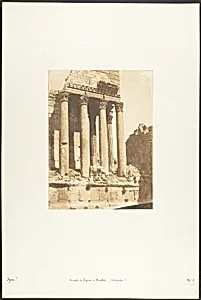
Temple de Jupiter, à Baâlbek (Héliopolis)
September 15, 1850
Medium
Salted paper print from paper negative
Dimensions
Image: 8 3/4 × 6 1/2 in. (22.2 × 16.5 cm) Mount: 12 5/16 × 18 11/16 in. (31.2 × 47.5 cm)
Classification
Photographs
Department
Photographs
Museum
Metropolitan Museum of Art, New York, NY
Credit
Gilman Collection, Gift of The Howard Gilman Foundation, 2005
Accession Number
2005.100.376.162
Rights
Public Domain
Tags
Art Historical Context
Step into the grandeur of ancient Rome through Maxime Du Camp's *Temple de Jupiter, à Balbek (Héli)*, a salted paper print captured on September 15, 0. This evocative photograph depicts the towering columns and weathered ruins of the Temple of Jupiter at Baalbek, Lebanon—once Heliopolis, a sprawling Roman sanctuary rivaling the wonders of the classical world. Du Camp, a pioneering French photographer and writer, immortalized these colossal structures, whose massive stone blocks still puzzle historians with their engineering feats from the 1st century AD. Created just a decade after photography's invention, this image stems from Du Camp's epic 1849–1850 journey across Egypt and the Levant alongside Gustave Flaubert. As one of the first to document Middle Eastern antiquities photographically, Du Camp's work bridged East and West, making remote ruins accessible to 19th-century audiences hungry for Orientalist exploration. Published in his seminal album *Egypte, Nubie, Palestine et Syrie* (1852), it fueled scholarly and public fascination with biblical and classical heritage. The salted paper print from a paper negative—using William Henry Fox Talbot's calotype process—marks a technical milestone. This early method allowed multiple prints from a single negative, capturing subtle tones and textures of the sun-baked stones with remarkable fidelity. Housed in The Metropolitan Museum of Art's Gilman Collection, it invites us to ponder the endurance of human ambition amid time's decay.
About the Artist
Maxime Du Camp · 1822–present
Maxime Du Camp (1822–1894) was a pioneering French photographer and writer whose adventurous spirit and technical innovation bridged literature and visual art during the mid-19th century. Born in Paris on February 8, 1822, to a prosperous family—his father a successful surgeon—Du Camp received a solid bourgeois education at the Collège Bourbon (now Lycée Condorcet), where he cultivated interests i...