
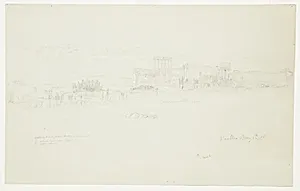
Temple of Jupiter, Baalbek, Syria
May 6, 1868
Classification
landscapes
Department
Smithsonian Collection
Museum
Smithsonian American Art Museum
Credit
Gift of Louis P. Church
Accession Number
1917-4-517
Rights
Public Domain
About this artwork
Research in Progress
Art Historical Context
Frederic Edwin Church, leading figure of the Hudson River School, captured the awe-inspiring ruins of the Temple of Jupiter in Baalbek Syria, in this 1868 landscape. Painted on May 6 during his extensive travels through the Middle East, the work reflects Church's passion for documenting grand natural and historical sites. As one of America's foremost 19th-century landscape artists, blended meticulous observation with a sense of the sublime, evoking the scale of ancient architecture against vast skies and rugged terrain. The Temple of Jupiter, part of Baalbek's monumental Roman complex—among the largest ever built—symbolizes the enduring power of classical antiquity. Church's visit came amid growing Western fascination with biblical lands and Orientalism, where artists sought spiritual and exotic inspiration. His landscapes often infused American wilderness ideals with global wonders, bridging personal exploration and cultural heritage. Housed in the Smithsonian American Art Museum as a gift from Church's son, Louis P. Church, this piece highlights the artist's on-site sketching technique, prioritizing atmospheric light and intricate detail. Though research continues, it stands as a vivid window into 19th-century American encounters with the ancient world.