
Tentation de Saint-Antoine (2)
1888 - 1889
Medium
lithography
Dimensions
289; 548; 359; 232
Rights
Public Domain
About this artwork
lithografie, chine collé
Art Historical Context
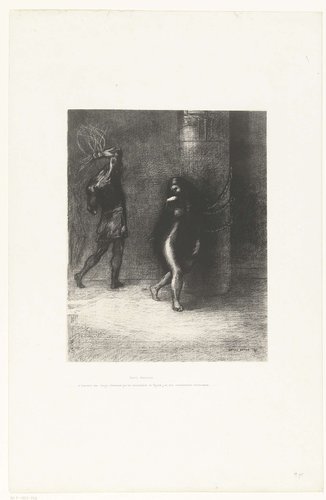
Odilon Redon's *Tentation de Saint-Antoine (2)* (1888–1889) captures the haunting visions of Saint Anthony the Great, a recurring motif in Western art symbolizing spiritual torment and divine temptation. As part of Redon's celebrated series of 14 lithographs inspired by Gustave Flaubert's 1874 novel *La Tentation de Saint Antoine*, this work immerses viewers in the artist's dreamlike Symbolist world. Created during the fin-de-siècle era, when Symbolism emerged as a counterpoint to Impressionism's focus on the external world, Redon's "Noirs"—his masterful black-and-white prints—evoke the subconscious, blending fantasy with psychological depth. Rendered in lithography on chine collé—a refined technique where delicate Chinese paper is adhered to a sturdy support for enhanced subtlety and texture—this 289 × 232 mm print exemplifies Redon's innovative printmaking. Lithography allowed him to achieve velvety tones and ethereal halos through grease crayon and tusche, producing smoky atmospheres that blur reality and hallucination, much like the saint's demonic apparitions. Redon's series marked a pinnacle of 19th-century Symbolist printmaking, influencing later Surrealists like Max Ernst. For visitors, it offers a portal to the mystical, reminding us how art can conjure the invisible struggles of the soul.
About the Artist
Odilon Redon · 1840–1916
Odilon Redon (1840-1916) was a French Symbolist painter, printmaker, and pastellist whose visionary art bridged the 19th-century Symbolist movement and 20th-century Surrealism. Born Bertrand Redon in Bordeaux on April 20, 1840, he earned the nickname "Odilon" from his mother Odile. His father, who made his fortune in the Louisiana slave trade, conceived Odilon in New Orleans before the family retu...