
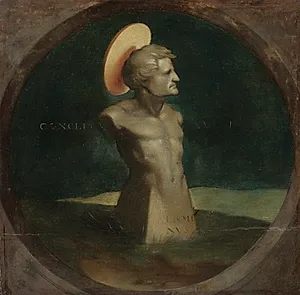
Terminus, the Device of Erasmus
Medium
oil on wood
Dimensions
unframed: 21.6 × 21.6 cm · framed: 32.4 × 32.4 × 4.5 cm
Classification
Painting
Department
European Painting and Sculpture
Museum
Cleveland Museum of Art
Credit
Gift of Dr. and Mrs. Sherman E. Lee in memory of Milton S. Fox
Accession Number
1971.166
Rights
Public Domain
Tags
About this artwork
In the spirit of the Italian Renaissance, Erasmus of Rotterdam (c. 1466–1536), the celebrated Dutch humanist and scholar, embraced ancient Greek and Roman literature and incorporated much of its moral and ethical messages into his own work. Holbein here conflates Erasmus’s features with Terminus, the Roman god of boundaries, who defied Jupiter by maintaining his position atop Capitoline Hill. Erasmus adopted Terminus, along with the motto concedo nulli (I concede to no one), as a personal symbol...