
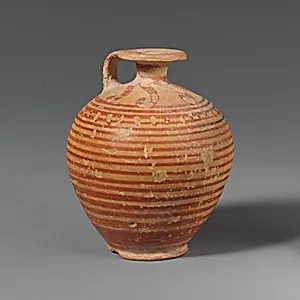
Terracotta aryballos (oil flask)
Unknown Artist
late 8th–early 7th century BCE
Medium
Terracotta
Dimensions
H. 2 9/16 in. (6.5 cm)
Classification
Vases
Culture & Period
Greek, Corinthian · Protocorinthian
Department
Greek and Roman Art
Museum
Metropolitan Museum of Art, New York, NY
Credit
Rogers Fund, 1922
Accession Number
22.139.88
Rights
Public Domain
Art Historical Context
This delicate terracotta aryballos or oil flask, hails from Corinth in ancient Greece during the Protocorinth period (late 8th–early 7th century BCE Standing just 2 9/16 inches (6.5 cm) tall, it exemplifies the exquisite miniaturist craft of Corinthian potters, who were pioneers in producing finely detailed vases amid the Geometric-to-Orientalizing transition.balloi like this were practical yet luxurious items, designed to hold perfumed oils for grooming, athletics, or funerary rites, often carried by a handle for easy suspension. Protocorinthian pottery marks a pivotal shift in Greek art, blending local Geometric abstraction with Eastern-inspired motifs like animals and rosettes, painted in slip on wheel-thrown clay before firing. Though small, these flasks showcase technical virtuosity—incised details and precise black-figure precursors—that influenced later Archaic styles across the Mediterranean. Corinth dominated the export trade, spreading Hellenic culture through such everyday treasures. Acquired through the Rogers Fund in 1922, this aryballos now graces the Metropolitan Museum of Art's Greek and Roman Art department, offering a tangible glimpse into the vibrant daily life and artistic innovation of early Archaic Greece.