
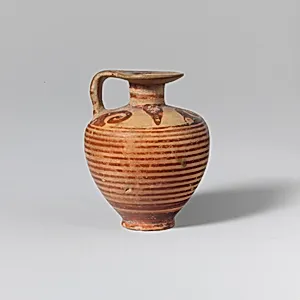
Terracotta aryballos (oil flask)
Unknown Artist
late 8th–early 7th century BCE
Medium
Terracotta
Dimensions
H. 2 in. (5.1 cm)
Classification
Vases
Culture & Period
Greek, Corinthian · Protocorinthian
Department
Greek and Roman Art
Museum
Metropolitan Museum of Art, New York, NY
Credit
Gift of Albert Gallatin, 1923
Accession Number
23.193
Rights
Public Domain
Art Historical Context
This petite terracotta aryballos or oil flask, hails from Corinthian Greece during the Protocorinthian (late 8th–early 7th century BCE Standing just 2 inches (5.1 cm) tall, its compact, round-bodied form with a narrow neck and chain handle made it perfectly portable—ideal for Greek men to carry scented oils for anointing the body, especially after bathing or athletic pursuits. Crafted from fired clay, a staple medium for ancient Greek pottery, it exemplifies the era's innovative vase-making traditions. The Protocorinthian style marked a pivotal shift in Greek art, bridging Geometric austerity toward the lively Orientalizing motifs of later centuries. Corinthian workshops excelled in these miniature vessels, showcasing technical prowess in shaping and firing terracotta to withstand daily use while hinting at emerging decorative ambitions. Though unattributed to a specific artist, such aryballoi highlight Corinth's dominance in early Archaic pottery export, influencing broader Mediterranean trade. Today, this charming survivor graces the Metropolitan Museum of Art's Greek and Roman Art department, a gift from Albert Gallatin in 1923. It offers a tangible glimpse into the intimate rituals of ancient Greek life, reminding us how everyday objects carried profound cultural weight.