
Terracotta aryballos (oil flask)
ca. 550 BCE
Medium
Terracotta
Dimensions
H. 3 1/4 in. (8.3 cm) diameter 3 1/2 in. (8.9 cm)
Classification
Vases
Culture & Period
Greek, Attic · Archaic
Department
Greek and Roman Art
Museum
Metropolitan Museum of Art, New York, NY
Credit
Rogers Fund, 1962
Accession Number
62.11.11
Rights
Public Domain
Tags
Art Historical Context
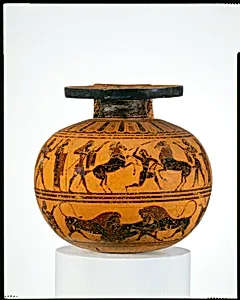
This small terracotta aryballos, or oil flask, displays a compact spherical body with a short neck and flat mouth. Its surface is painted in the black-figure technique, with dark silhouetted forms set against the warm orange clay. Two horizontal friezes encircle the vessel: the upper band shows riders on horseback accompanied by standing figures, while the lower register features a procession of animals, including lions or similar beasts, rendered with careful incision and added color accents. Attributed to the Amasis Painter, this vase dates to around 550 BCE and belongs to the Archaic period of Greek, Attic art. The artist was known for his precise drawing and lively compositions on vessels of various shapes. Aryballoi like this one held perfumed oils and were common in both daily use and ritual contexts. The scenes reflect themes popular in sixth-century Athens, including processions and encounters with animals. As a work now in the Metropolitan Museum of Art, it offers visitors a direct glimpse into the refined craftsmanship and storytelling traditions of early Greek vase painting.