
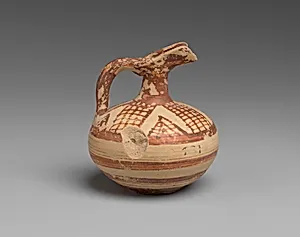
Terracotta beak-spouted jug
Unknown Artist
ca. 1300–1200 BCE
Medium
Terracotta
Dimensions
H. 2 3/4 in. (7 cm)
Classification
Vases
Culture & Period
Helladic, Mycenaean · Late Helladic IIIB
Department
Greek and Roman Art
Museum
Metropolitan Museum of Art, New York, NY
Credit
The Cesnola Collection, Purchased by subscription, 1874–76
Accession Number
74.51.750
Rights
Public Domain
Art Historical Context
This delicate terracotta beak-spouted, dating to around 1300–1200 BCE, hails from the Mycenaean culture of Late Helladic IIIB—a era in Bronze Age Greece. Standing just 2 3/4 inches (7 cm) tall, its compact form and distinctive spout suggest it was designed for practical use, likely pouring liquids like water, wine, or oil in a domestic setting. Crafted from fired clay, terracotta was a staple medium for Mycenaean potters, valued for its durability and accessibility, allowing everyday vessels to endure for millennia. Mycenaean society, known for its fortified palaces like those at Mycenae and Pylos, blended Minoan influences with warrior-like prowess, as evoked in Homer's epics. Such jugs offer a glimpse into their daily life, revealing sophisticated wheel-throwing techniques and simple, functional shapes that prioritized utility over ornate decoration. Though unadorned, this piece exemplifies the era's pottery evolution, bridging earlier Helladic traditions toward the Geometric style of Archaic Greece. Now part of The Cesnola Collection at The Metropolitan Museum of Art—acquired through public subscription in 1874–76—this jug connects us to a mysterious civilization whose collapse around 1200 BCE ushered in the Greek Dark Ages, making humble artifacts like this invaluable windows into lost worlds.