
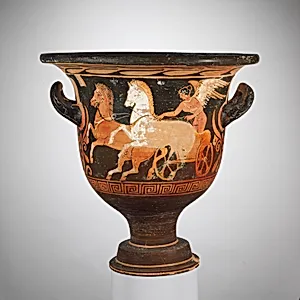
Terracotta bell-krater (mixing bowl)
ca. 360–330 BCE
Medium
Terracotta
Dimensions
H. 12 1/8 in. (30.8 cm)
Classification
Vases
Culture & Period
Greek, South Italian, Campanian · Late Classical
Department
Greek and Roman Art
Museum
Metropolitan Museum of Art, New York, NY
Credit
Rogers Fund, 1906
Accession Number
06.1021.236
Rights
Public Domain
Tags
Art Historical Context
This terracotta bell-krater, crafted in Campania, South Italy around 360–330 BCE, exemplifies the vibrant ceramic traditions of Greek colonial communities during the Late Classical period. As a mixing bowl for wine and water, it played a central role in symposia and social gatherings, blending practical use with elaborate decoration. The vessel’s form—characterized by its bell-shaped body and sturdy handles—allowed for easy pouring while providing ample space for narrative scenes. Attributed to the Whiteface Painter, the krater showcases the distinctive South Italian style, where figures often feature pale faces created through applied slips. Its painted imagery includes men, the winged god Eros, horses, and chariots, evoking themes of myth, competition, or heroic procession common in Greek art of the era. Such vessels highlight how Greek artistic practices flourished beyond the mainland, adapting Athenian influences to local tastes. Acquired by the Metropolitan Museum through the Rogers Fund in 1906, this piece offers visitors a glimpse into the cultural exchanges of the ancient Mediterranean. Its preservation underscores the enduring appeal of these functional artworks as both everyday objects and storytelling canvases.