
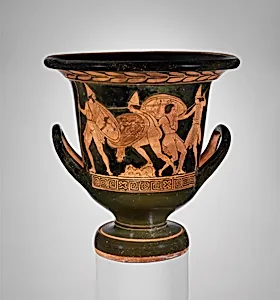
Terracotta calyx-krater (mixing bowl)
ca. 430–400 BCE
Medium
Terracotta
Dimensions
H. 15 1/16 in. (38.3 cm); diameter of mouth 14 9/16 in. (37 cm)
Classification
Vases
Culture & Period
Greek, South Italian, Lucanian · Classical
Department
Greek and Roman Art
Museum
Metropolitan Museum of Art, New York, NY
Credit
Rogers Fund, 1921
Accession Number
21.88.75
Rights
Public Domain
Tags
About this artwork
This terracotta calyx-krater exemplifies the sophisticated artistry of South Italian Greek pottery during the Classical period. Attributed to the Amykos Painter, who worked in Lucania around 430-400 BCE, the vessel illustrates the complex interrelation between Greek art and indigenous populations in Southern Italy. The obverse depicts four warriors engaged in combat, while the reverse shows four youths in a more peaceful arrangement. The warriors are portrayed with native Italic helmets rather t...
Art Historical Context
Step into the vibrant world of ancient South Italy with this stunning terracotta calyx-kr, crafted by the Amykos around 430–400 BCE. Hailing from Lucania in Magna Graecia—the Greek colonies of southern Italy—this mixing bowl stands 15 inches tall with a wide 14½-inch mouth, perfect for wine and water at lively symposia. Attributed to the Amykos Painter, a master of the Classical period, it showcases red-figure pottery, a technique pioneered in Athens circa 530 BCE that reserved clay's natural red color for figures, allowing intricate black-line details for more naturalistic poses. On one side, four fierce warriors clash in battle, their native Italic helmets blending Greek and local Italic styles—a testament to cultural fusion in this colonial hub. The other side offers a serene contrast with four youths, emphasizing fluid individual movement over the stiff compositions of Athenian vases. This shift highlights the Amykos Painter's innovative style, adapting Attic traditions to regional tastes. Acquired by the Metropolitan Museum of Art in 1921, this vessel not only served practical purposes but also narrated stories of conflict and camaraderie, bridging Greek artistry with indigenous influences in a dynamic era of exchange.