
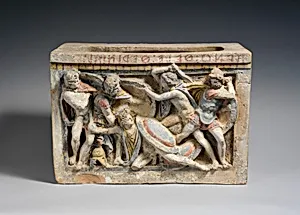
Terracotta cinerary urn
Unknown Artist
3rd–2nd century BCE
Medium
Terracotta
Dimensions
15 1/2 x 22 x 11 in. (39.4 x 55.9 x 27.9 cm)
Classification
Terracottas
Culture & Period
Etruscan · Hellenistic
Department
Greek and Roman Art
Museum
Metropolitan Museum of Art, New York, NY
Credit
Purchase, Mr. and Mrs. Harry G. Friedman Gift, 1957
Accession Number
57.11.10
Rights
Public Domain
Tags
Art Historical Context
This striking terracotta cinerary urn crafted by an unknown Etruscan artist in the 3–2nd century BCE the Hellenistic period, served as a vessel for crem ashes, reflecting the Etruscans' deep cultural emphasis on honoring the dead. Hailing from ancient central Italy, where the Etruscans thrived before Roman dominance, such urns were common in tombs, blending funerary ritual with vivid storytelling. Measuring 15½ x 22 x 11 inches, its substantial size allowed for intricate reliefs, likely depicting dynamic battle scenes—a tag that evokes the warrior ethos celebrated in Etruscan society. Terracotta, fired clay molded and often painted, was a hallmark Etruscan medium, prized for its durability and affordability compared to marble. Artisans hand-built or wheel-thrown these pieces, then carved detailed friezes before firing, capturing movement and emotion in high relief. The Hellenistic influence is evident in the dramatic poses and realism, bridging Greek artistic ideals with local Italic traditions, making this urn a window into evolving Mediterranean aesthetics. Now at the Metropolitan Museum of Art, thanks to a 1957 gift from Mr. and Mrs. Harry G. Friedman, it invites us to ponder Etruscan valor and mortality—timeless themes etched in earthy clay.