
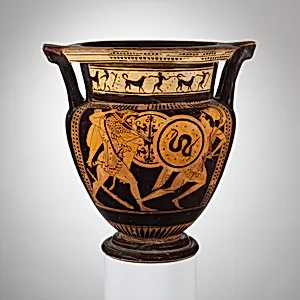
Terracotta column-krater (bowl for mixing wine and water)
ca. 500 BCE
Medium
Terracotta
Dimensions
Height: 13 7/16 in. (34.2 cm) Diameter: 10 13/16 in. (27.5 cm) Width (with handles): 13 1/8 in. (33.3 cm)
Classification
Vases
Culture & Period
Greek, Attic · Late Archaic
Department
Greek and Roman Art
Museum
Metropolitan Museum of Art, New York, NY
Credit
Edward C. Moore Collection, Bequest of Edward C. Moore, 1891
Accession Number
91.1.462
Rights
Public Domain
Tags
Art Historical Context
This terracotta column-krater, created around 500 BCE in Athens during the Late Archaic period, served a central role in Greek social life as a vessel for mixing wine and water at symposia. Standing just over 13 inches tall, its sturdy form with distinctive columnar handles reflects the practical yet elegant design favored by Attic potters. Such kraters were not merely utilitarian; they often took pride of place in gatherings where conversation, poetry, and ritual drinking intertwined. Attributed to the Göttingen Painter, the vase exemplifies the transition in Attic ceramics from black-figure to early red-figure techniques. Its painted decoration, featuring men, animals, and shields, likely evokes heroic or mythological themes common in the era, inviting viewers to connect everyday feasting with epic narratives. As part of the Metropolitan Museum’s Greek and Roman collection, this piece highlights how Athenian artisans elevated humble clay into sophisticated storytelling objects that bridged art, myth, and daily ritual.
About the Artist
Göttingen Painter
**The Göttingen Painter** was an Attic Greek vase painter active in the early fifth century BCE, during the transition from the Late Archaic to the Early Classical period. Named by scholars after a fragmentary column-krater in the collection of the University of Göttingen that depicts a lively komos scene, he is recognized primarily through stylistic attributions rather than any signed works. His ...