
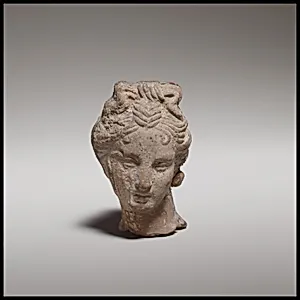
Terracotta female head
Unknown Artist
2nd century CE
Medium
Terracotta
Dimensions
H. 1 7/8 in. (4.8 cm)
Classification
Terracottas
Culture & Period
Greek, Asia Minor, Smyrna ? · Roman
Department
Greek and Roman Art
Museum
Metropolitan Museum of Art, New York, NY
Credit
The Cesnola Collection, Purchased by subscription, 1874–76
Accession Number
74.51.1513
Rights
Public Domain
Tags
Art Historical Context
This delicate terracotta female head, dating to the 2nd century CE, hails from the Greek culture of Asia Minor—possibly the vibrant city of Smyrna (modern-day İzmir, Turkey)—during the Roman period. Standing just 1 7/8 inches (4.8 cm) tall, it exemplifies the intimate scale of ancient terracotta figurines, crafted from fired clay that made artistry accessible beyond elite marble sculptures. Now part of the Metropolitan Museum of Art's Greek and Roman Art Department, it entered the collection through The Cesnola Collection, acquired by public subscription in 1874–76. Terracotta was a favored medium in the Hellenistic and Roman eras for its versatility, allowing artisans to mold fine details like flowing hair, expressive features, and subtle drapery with relative ease and affordability. These small heads often served as votive offerings in sanctuaries, decorations in homes, or even theatrical masks, reflecting everyday devotion to female deities like Artemis or Demeter, or idealized portraits of women. Though the artist remains unknown, the piece captures the enduring Greek influence in Roman Asia Minor, where Eastern Mediterranean cultures blended seamlessly. Visitors will appreciate its tactile charm—imagine holding a fragment of antiquity that whispered stories of ancient rituals and daily life, preserved for over 1,800 years.