
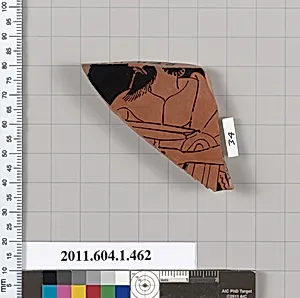
Terracotta fragment of a kylix (drinking cup)
490–480 BCE
Medium
Terracotta
Classification
Vases
Culture & Period
Greek, Attic · Late Archaic
Department
Greek and Roman Art
Museum
Metropolitan Museum of Art, New York, NY
Credit
Gift of Dietrich von Bothmer, Distinguished Research Curator, Greek and Roman Art, 2011
Accession Number
2011.604.1.462
Rights
Public Domain
Art Historical Context
This exquisite terracotta fragment from a kylix, or shallow drinking cup, dates to 490–480 BCE and hails from Attic Greece during the Late Archaic period Attributed to the masterful vase-painter Makron, one of the era's most prolific artists, it exemplifies the height of red-figure pottery—a revolutionary technique where figures were outlined in black slip on a red clay ground, allowing intricate details to emerge through careful incision and sparing paint application. Makron, often collaborating with potter Hieron, specialized in these elegant kylikes, which were prized at symposia, the all-male drinking parties central to Greek social life. As a fragment, it offers a tantalizing glimpse into daily or mythic scenes typical of Makron's work, showcasing his fluid lines, dynamic compositions, and keen sense of narrative. Terracotta vases like this were not mere vessels but canvases for storytelling, bridging the Archaic world's stylized forms toward the more naturalistic Classical style. Donated to the Metropolitan Museum of Art in 2011 by Dietrich von Bothmer, this piece highlights the enduring allure of Attic ceramics, which influenced art across the ancient Mediterranean and continue to captivate us with their vibrant preservation and cultural insights.
About the Artist
Makron
Makron stands as one of the most prolific masters of Attic red-figure vase painting, active in Athens around 490–480 BC during the late Archaic to early Classical transition.) Little is known of his early life or formal training, as such details remain undocumented for many ancient potters and painters of this era. Exclusively employing the red-figure technique—which allowed for intricate detailin...