
Terracotta fragment of a kylix (drinking cup)
500–480 BCE
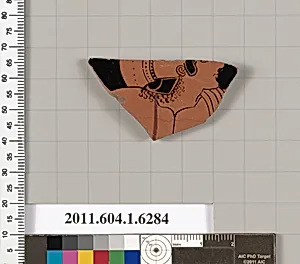
Medium
Terracotta
Classification
Vases
Culture & Period
Greek, Attic · Archaic
Department
Greek and Roman Art
Museum
Metropolitan Museum of Art, New York, NY
Credit
Gift of Dietrich von Bothmer, Distinguished Research Curator, Greek and Roman Art, 2011
Accession Number
2011.604.1.6284
Rights
Public Domain
Art Historical Context
This terracotta fragment once formed part of a kylix, a shallow drinking cup central to ancient Greek social life. Created in Athens between 500 and 480 BCE during the Archaic period, it was painted by Onesimos, an accomplished Attic artist whose works helped bridge the transition from black-figure to the more expressive red-figure technique. Such vessels were used in symposia, where men gathered to share wine, conversation, and poetry, turning everyday objects into vehicles for artistic storytelling. Onesimos’s hand is evident in the refined drawing and attention to human form that characterize his surviving pieces. Though only a fragment remains, it highlights the remarkable skill of Athenian potters who shaped and fired terracotta into durable, elegant forms that were traded across the Mediterranean. These cups were both practical and prized possessions, often decorated with scenes from myth or daily life. Today, this shard in the Metropolitan Museum’s collection offers visitors a tangible connection to the artistic innovations of early classical Greece and the cultural rituals that shaped them. Its survival reminds us how even small remnants can illuminate the sophistication of an entire civilization.
About the Artist
Onesimos
**Onesimos** was an ancient Athenian vase painter who flourished in Athens around 500–480 BC. Specializing in the red-figure technique during the Early Classical period, he focused primarily on decorating drinking cups, most often of Type B. Over two hundred vessels have been attributed to him, reflecting his prolific output and high demand in the Attic pottery workshops.) His training appears cl...