
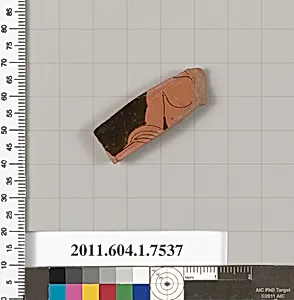
Terracotta fragment of a kylix (drinking cup)
460–450 BCE
Medium
Terracotta
Classification
Vases
Culture & Period
Greek, Attic · Classical
Department
Greek and Roman Art
Museum
Metropolitan Museum of Art, New York, NY
Credit
Gift of Dietrich von Bothmer, Distinguished Research Curator, Greek and Roman Art, 2011
Accession Number
2011.604.1.7537
Rights
Public Domain
Art Historical Context
This elegant terracotta fragment once formed part of a kylix, the shallow, stemmed drinking cup favored in ancient Athens during the Classical period. Created between 460 and 450 BCE by the Euaion Painter, an Attic vase-painter known for his refined red-figure work, the piece reflects the height of Athenian artistic achievement in the decades following the Persian Wars. The red-figure technique allowed the artist to render human figures with greater naturalism and detail against the warm clay background, a technical advance that transformed Greek vase painting. Kylikes like this one played a central role in the symposium, the all-male drinking gatherings that blended social bonding, intellectual conversation, and ritual. Their wide, shallow bowls encouraged careful handling while showcasing painted scenes visible as the cup was raised or passed. Though only a fragment survives, its attribution to the Euaion Painter connects it to a circle of artists who favored graceful figures and subtle narratives drawn from mythology and daily life. Housed in the Metropolitan Museum of Art’s Greek and Roman collection, this modest shard offers visitors a tangible link to the sophisticated visual culture of fifth-century Athens. Its gift by curator Dietrich von Bothmer underscores the ongoing role of scholarship in illuminating even the smallest remnants of antiquity.
About the Artist
Euaion Painter
**The Euaion Painter** was an ancient Greek Attic vase painter active in Athens from approximately 460 to 440 BCE. Like most vase painters of the period, his true name remains unknown; scholars named him after the inscription “Euaion kalos” (“Euaion the fair”) that appears on one of his works now in the Louvre. This Euaion was the son of the tragedian Aeschylus and a favorite subject of contempora...