
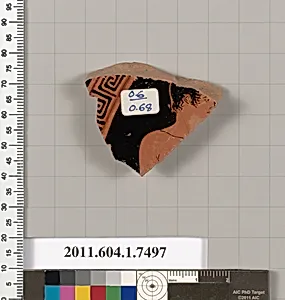
Terracotta fragment of a kylix (drinking cup)
460–450 BCE
Medium
Terracotta
Classification
Vases
Culture & Period
Greek, Attic · Classical
Department
Greek and Roman Art
Museum
Metropolitan Museum of Art, New York, NY
Credit
Gift of Dietrich von Bothmer, Distinguished Research Curator, Greek and Roman Art, 2011
Accession Number
2011.604.1.7497
Rights
Public Domain
Art Historical Context
This terracotta fragment of a kylix, or shallow drinking cup, offers a glimpse into the refined world of ancient Athenian social life during the Classical period. Created between 460 and 450 BCE in Attica, Greece, such vessels were central to the symposium—a gathering of men for drinking, conversation, and intellectual exchange. The Euaion Painter, to whom this piece is attributed, worked in the red-figure technique typical of Attic vase production, allowing for greater naturalism and detail in figural scenes compared to earlier black-figure styles. As a fragment preserved in the Metropolitan Museum of Art, this work highlights the remarkable survival of Greek pottery through centuries. Terracotta was the preferred medium for everyday luxury items, valued for its versatility in shaping and its ability to hold intricate painted decoration. Though only a portion remains, it connects us directly to the artistic achievements of fifth-century BCE Athens, a time of cultural flourishing under leaders like Pericles. The kylix form itself underscores the blend of utility and artistry in Greek culture, where even functional objects became vehicles for storytelling and aesthetic expression. Donated by a distinguished curator, this artifact continues to educate visitors about the elegance and sophistication of Classical Greek craftsmanship.
About the Artist
Euaion Painter
**The Euaion Painter** was an ancient Greek Attic vase painter active in Athens from approximately 460 to 440 BCE. Like most vase painters of the period, his true name remains unknown; scholars named him after the inscription “Euaion kalos” (“Euaion the fair”) that appears on one of his works now in the Louvre. This Euaion was the son of the tragedian Aeschylus and a favorite subject of contempora...