
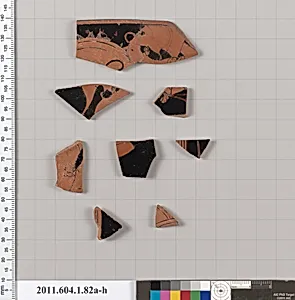
Terracotta fragments of a kylix (drinking cup)
Unknown Artist
520–500 BCE
Medium
Terracotta
Classification
Vases
Culture & Period
Greek, Attic · Archaic
Department
Greek and Roman Art
Museum
Metropolitan Museum of Art, New York, NY
Credit
Gift of Dietrich von Bothmer, Distinguished Research Curator, Greek and Roman Art, 2011
Accession Number
2011.604.1.82a–h
Rights
Public Domain
Art Historical Context
These terracotta fragments come from a kylix, a shallow, two-handled drinking cup central to ancient Greek symposia—lively social gatherings where men reclined, shared wine, recited poetry, and debated philosophy. Dating to the late Archaic period (520–500 BCE), this Attic piece hails from Athens, the epicenter of Greek pottery production. Craftsmen shaped the clay on a potter's wheel, fired it in kilns, and likely adorned it with painted scenes using the black-figure technique—silhouetted figures incised with details—or the emerging red-figure style, where backgrounds were painted black to highlight reserved clay figures. Though incomplete, these shards offer a window into Archaic Greek artistry and daily life. Attic vases like this were not just functional but status symbols, exported across the Mediterranean and often depicting myths, athletes, or revelers. Their durability made them archaeological treasures, preserving cultural narratives long after the symposia ended. Generously gifted to the Metropolitan Museum of Art in 2011 by Dietrich von Bothmer, these fragments remind us of the ingenuity of anonymous ancient artisans whose work influenced Western art for millennia.