
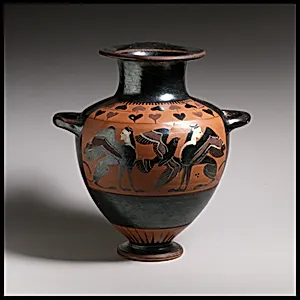
Terracotta hydria (water jar)
Unknown Artist
mid-6th century BCE
Medium
Terracotta
Dimensions
H. 8 15/16 in. (22.7 cm)
Classification
Vases
Culture & Period
Greek, Euboean · Archaic
Department
Greek and Roman Art
Museum
Metropolitan Museum of Art, New York, NY
Credit
Rogers Fund, 1968
Accession Number
68.11.40
Rights
Public Domain
Tags
Art Historical Context
This charming terracotta hydria, water jar, hails from Euboea, a vibrant Greek island known for its pottery workshops in the Archaic period (c. 800–480 BCE). Dating to the mid-6th century, this modestly sized vessel—standing just under 9 inches tall—was a practical everyday object in ancient households, used to fetch, store, and pour water thanks to its distinctive three handles: two horizontal ones for lifting and a vertical one for pouring. Euboean potters blended influences from neighboring Attic and Corinthian styles creating wares that were both functional and beautifully decorated. Crafted in terracotta using the black-figure technique—where figures were painted in slip and incised to reveal the clay beneath—this hydria likely features dynamic motifs of eagles and a sphinx, mythical guardians symbolizing power and mystery in Greek lore. The sphinx, with its human head, lion's body, and wings, echoes Eastern influences filtering into Greek art via trade routes, while eagles evoke Zeus's divine messengers. These bold, silhouetted designs highlight the Archaic emphasis on symmetry, narrative storytelling, and mythological themes, bridging utility and artistry. Now part of the Metropolitan Museum of Art's Greek and Roman collection (acquired via the Rogers Fund in 1968), this hydria offers a window into daily life and cosmology of Archaic Greece, reminding us how even humble pots carried profound cultural weight.