
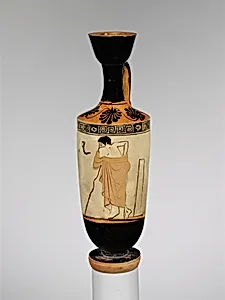
Terracotta lekythos (oil flask)
Unknown Artist
1st quarter of 5th century BCE
Medium
Terracotta
Dimensions
H. 10 1/4 in. (26 cm)
Classification
Vases
Culture & Period
Greek, Attic · Late Archaic
Department
Greek and Roman Art
Museum
Metropolitan Museum of Art, New York, NY
Credit
Gift of Mrs. Harry G. Friedman, 1953
Accession Number
53.149
Rights
Public Domain
Tags
Art Historical Context
This delicate terracotta lekyth, an ancient Greek oil flask from Attic workshops in the late Archaic (first quarter of 5th century BCE), stands just 10¼ inches tall. Lekythoi like this one were essential everyday vessels, wheel-thrown from fine clay and fired to a warm reddish hue. Primarily used to hold olive oil or perfumes, they held special significance in funerary rituals, often placed in tombs as offerings to the deceased—a poignant glimpse into ancient Greek beliefs about the afterlife. Adorned with characteristic palmette motifs—stylized palm leaves forming elegant borders—and figures of men, the vase exemplifies the black-figure technique dominant in Attic pottery at the time. Artists incised details into the glossy black slip before firing, creating crisp outlines that pop against the reserved clay background. This anonymous master's work captures the refined geometry and narrative flair of late Archaic style, bridging the rigid forms of earlier Geometric art and the fluid humanism of the Classical era. Housed in the Metropolitan Museum of Art's Greek and Roman Art Department (gift of Mrs. Harry G. Friedman, 1953), this lekythos invites us to imagine bustling Athenian potters' quarters, where such vessels fueled both daily life and eternal journeys. A testament to enduring craftsmanship, it whispers stories of a vibrant ancient world.