
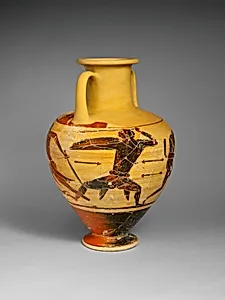
Terracotta neck-amphora (jar)
late 6th century BCE
Medium
Terracotta
Dimensions
H.: 15 7/8 in. (40.3 cm)
Classification
Vases
Culture & Period
Etruscan · Archaic
Department
Greek and Roman Art
Museum
Metropolitan Museum of Art, New York, NY
Credit
Rogers Fund, 1910
Accession Number
10.210.9
Rights
Public Domain
Tags
Art Historical Context
This elegant terracotta neck-amph, standing at 15⅞ inches tall, hails from the late 6th century BCEic period and is attributed to the Painter of the Vienna Stamnos 318 an anonymous Athenian artist renowned for his black-figure vase painting. Crafted in Attic Greece but associated with Etruscan culturelikely imported and prized by the ancient Etruscans of central Italy—this two-handled jar was used for storing wine or oil, blending everyday utility with stunning artistry. Acquired by The Metropolitan Museum of Art through the Rogers Fund in 1910, it exemplifies the vibrant exchange between Greek potters and Etruscan elites. The vase's decoration, featuring men armed with bows and arrows, captures dynamic scenes of hunting or warfare, a popular motif in Archaic Greek art symbolizing heroism and prowess. The black-figure technique—incising details into glossy black slip fired against the orange clay—allowed for intricate storytelling, with added white and purple highlights enhancing figures' musculature and attire. This method, at its peak in the 6th century BCE, showcases the painter's skill in composition and narrative, bridging the geometric rigidity of earlier styles with emerging naturalism. In Etruscan hands, such vases held ritual or funerary significance, reflecting cultural fusion across the ancient Mediterranean. A testament to enduring craftsmanship, this amphora invites us to imagine ancient banquets or tombs alive with mythic valor.