
Terracotta pyxis (box)
ca. 590–570 BCE
Medium
Terracotta
Dimensions
H.: 6 3/8 in. (16.2 cm)
Classification
Vases
Culture & Period
Greek, Corinthian · Middle Corinthian
Department
Greek and Roman Art
Museum
Metropolitan Museum of Art, New York, NY
Credit
Rogers Fund, 1906
Accession Number
06.1021.21a, b
Rights
Public Domain
Tags
Art Historical Context
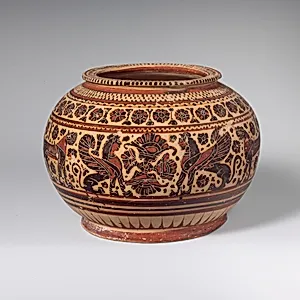
This exquisite terracotta pyxis, crafted by the Canessa Painter 590–570 BCE during the Middle Corinthian period exemplifies the artistry of ancient Corinth, a powerhouse of Greek pottery production. Standing just 6 3/8 inches tall, this small lidded box—known as a pyxis—was likely used by women to store cosmetics, jewelry, or trinkets, reflecting everyday luxury in Archaic Greece. Corinthian vases like this were prized exports, the city's mastery of the black-figure technique, where incised details and added purple and white pigments brought scenes to life on a glossy black background. The pyxis is adorned with dynamic friezes featuring a sphinx and panthers, iconic motifs in Corinthian animal-style decoration. The sphinx, a mythical guardian with a human head, lion's body, and bird's wings, flanks prowling panthers, symbolizing power and mystery in Greek mythology. These lively, precisely incised figures highlight the Canessa Painter's skill in capturing motion on a miniature scale, a hallmark of Middle Corinthian vases that bridged orientalizing influences with emerging Greek narratives. Acquired through the Rogers Fund in 1906, this piece at the Metropolitan Museum of Art offers a window into Corinth's cultural dominance and the sophisticated tastes of its ancient users, blending utility with enchanting storytelling.