
Storage Jar
Unknown Artist
7th century
Medium
Earthenware; painted, unglazed
Dimensions
H. 19 7/16 in. (49.4 cm) Max. Diam. 18 1/2 in. (47 cm) Diam. of Rim (interior): 11 5/8 in. (29.5 cm) Diam of Foot: 9 1/4 in. (23.5 cm)
Classification
Ceramics
Department
Islamic Art
Museum
Metropolitan Museum of Art, New York, NY
Credit
Rogers Fund, 1923
Accession Number
23.2.74
Rights
Public Domain
Tags
Art Historical Context
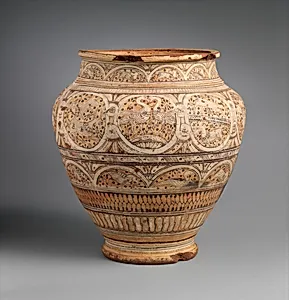
This 7th-century storage jar, crafted from unglazed earthenware and adorned with painted motifs, stands as a fine example of early Islamic ceramics from the Metropolitan Museum of Art's Islamic Art collection. Measuring nearly 20 inches tall with a wide body and sturdy foot, it was designed for practical use—likely storing grains, oils, or other goods in households or markets—while its decorative surface elevated it to an object of beauty. The unpainted clay's natural buff tone provided a warm canvas for the artist's slip-painted designs, a technique where liquid clay was applied before firing to create vibrant patterns that have endured for over 1,300 years. The jar's motifs of birds and animals reflect the artistic vitality of the early Islamic world, particularly in regions like Iraq or Syria during the 7th century, when pottery production flourished amid the rapid expansion of the Islamic caliphate. Unglazed earthenware was a hallmark of this era, affordable and accessible, allowing widespread decoration without the complexity of glazing. These lively creatures—possibly symbolizing abundance, protection, or daily life—hint at pre-iconoclastic traditions blending local Mesopotamian and Sasanian influences with emerging Islamic aesthetics. As a Rogers Fund acquisition from 1923, this jar offers visitors a tangible link to the everyday artistry of Islam's formative years, showcasing how utility and ornament intertwined in a burgeoning cultural golden age.